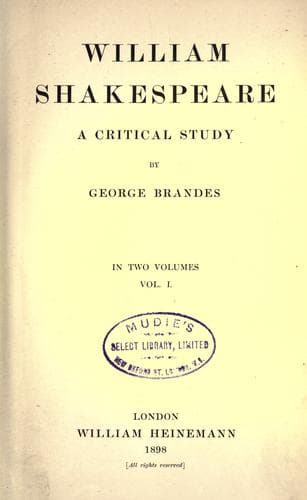
William Shakespeare: A Critical StudyBrandes, Georg
General
William Shakespeare: A Critical Study
Brandes, Georg
Shakespeare, William, 1564-1616 -- Criticism and interpretation
In spite of his worship of learning, his dislike to all handicraft, and
his unfitness for practical work, he was forced by poverty to break
off his studies in order to enter the employment of his bricklayer
stepfather--a fact which, in his subsequent literary feuds, always
procured him the nickname of "the bricklayer." He could not long endure
this occupation, went as a soldier to the Netherlands, killed one of
the enemy in single combat, under the eyes of both camps, returned to
London and married--almost as early as Shakespeare--at the age of only
nineteen. Twenty-six years later, in his conversations with Drummond,
he called his wife "a shrew, yet honest." He seems to have been an
affectionate father, but had the misfortune to survive his children.
He was strong and massive in body, racy and coarse, full of self-esteem
and combative instincts, saturated with the conviction of the scholar's
high rank and the poet's exalted vocation, full of contempt for
ignorance, frivolity, and lowness, classic in his tastes, with a bent
towards careful structure and leisurely development of thought in
all that he wrote, and yet a true poet in so far as he was not only
irregular in his life and quite incapable of saving any of the money he
now and then earned, but was, moreover, subject to hallucinations: once
saw Carthaginians and Romans fighting on his great toe, and, on another
occasion, had a vision of his son with a bloody cross on his brow,
which was supposed to forbode his death.
Like Shakespeare, he sought to make his bread by entering the theatre
and appearing as an actor. To him, as to Shakespeare, old pieces of the
repertory were entrusted to be rewritten, expanded, and furbished up.
Thus as late as 1601-2 he made a number of very able additions, in the
style of the old play, to that _Spanish Tragedy_ of Kyd's, which must
in many ways have been in Shakespeare's mind during the composition of
_Hamlet_.
He did this work on the commission of Henslow, for whose company, which
competed with Shakespeare's, he worked regularly from 1597 onwards. He
collaborated with Dekker in a tragedy, and had a hand in other plays;
in short, he made himself useful to the theatre as best he could, but
did not, like Shakespeare, acquire a share in the enterprise, and thus
never became a man of substance. He was to the end of his life forced
to rely for his income upon the liberality of royal and noble patrons.
Public-domain text, read in full here on John Shaqi.
Reviews
Reviews
No reviews yet
Be the first to share your thoughts on this work.
Elsewhere in the archive
Join the Discussion
Join the discussion
Sign in to leave a comment or review.
Sign InorCreate an account