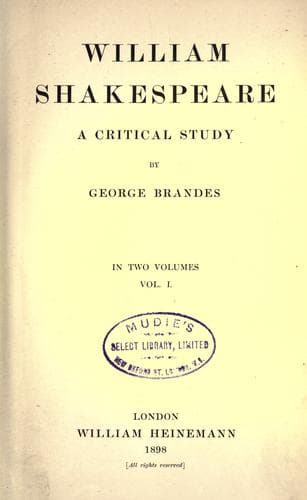
William Shakespeare: A Critical StudyBrandes, Georg
General
William Shakespeare: A Critical Study
Brandes, Georg
Shakespeare, William, 1564-1616 -- Criticism and interpretation
The end of 1598 is doubly significant in Ben Jonson's life. In
September he killed in a duel another of Henslow's actors, a certain
Gabriel Spencer (who seems to have challenged him), and was therefore
branded on the thumb with the letter T (Tyburn). A couple of months
later, this occurrence having evidently led to a break in his
connection with Henslow's company, his first original play, _Every Man
in his Humour_, was acted by the Lord Chamberlain's men. According to a
tradition preserved by Rowe, and apparently trustworthy, the play had
already been refused, when Shakespeare happened to see it and procured
its acceptance. It met with the success it deserved, and henceforward
the author's name was famous.
Even in the first edition of this play he makes Young Knowell speak
with warm enthusiasm of poetry, of the dignity of the sacred art of
invention, and express that hatred for every profanation of the Muses
which appears so frequently in later works, finding, perhaps, its most
vehement utterance in _The Poetaster_, where the young Ovid eulogises
his art in opposition to the scorn of his father and others. From the
first, too, he made no concealment of his strong sense of being at once
a high-priest of art, and, in virtue of his learning, an Aristarchus
of taste. He not only scorned all attempts to tickle the public ear,
but, with the firm and superior attitude of a teacher, he again and
again imprinted on spectators and readers what Goethe has expressed
in the well-known words: "Ich schreibe nicht, Euch zu gefallen; Ihr
sollt was lernen." Again and again he claimed for his own person the
sanctity and inviolability of art, and attacked his inferior rivals
unsparingly, with ferocious rather than witty satire. His prologues and
epilogues are devoted to a self-acclamation which was entirely foreign
to Shakespeare's nature. Asper in _Every Man out of his Humour_ (1599),
Crites in _Cynthia's Revels_ (1600), and Horace in _The Poetaster_
(1601), are so many pieces of self-idolising self-portraiture.
All who, in his judgment, degrade art are made to pay the penalty
in scathing caricatures. In _The Poetaster_, for example, his
taskmaster, Henslow, is presented under the name of Histrio as a
depraved slave-dealer, and his colleagues Marston and Dekker are
held up to ridicule under Roman names, as intrusive and despicable
scribblers. Their attacks upon the admirable poet Horace, whose name
and personality the extremely dissimilar Ben Jonson has arrogated to
himself, spring from contemptible motives, and receive a disgraceful
punishment.
Public-domain text, read in full here on John Shaqi.
Reviews
Reviews
No reviews yet
Be the first to share your thoughts on this work.
Elsewhere in the archive
Join the Discussion
Join the discussion
Sign in to leave a comment or review.
Sign InorCreate an account