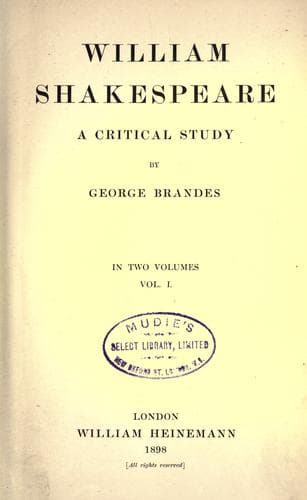
William Shakespeare: A Critical StudyBrandes, Georg
General
William Shakespeare: A Critical Study
Brandes, Georg
Shakespeare, William, 1564-1616 -- Criticism and interpretation
Ben Jonson possesses the undaunted insight and the vigorous
pessimism which render it possible to represent Roman depravity and
wild-beast-like ferocity under the first Emperors without extenuation
and without declamation. He cannot, indeed, dispense with a sort of
chorus of honourable Romans, but they express themselves, as a rule,
pithily and without prolixity; and he has enough sense of art and of
history never to let his ruffians and courtesans repent.
Now and then he even attains to a Shakespearian level. The scene in
which Sejanus approaches Eudemus first with jesting talk, and then,
with wily insinuations, worms himself into his acquaintance and makes
him his creature, while Eudemus, with crafty servility, shows that
he can take a half-spoken hint, and, without for a moment committing
himself, offers his services as pander and assassin--this passage is in
no way inferior to the scene in Shakespeare's _King John_ in which the
King suggests to Hubert the murder of Arthur.
The most remarkable scene, however, is that (v. 10) in which the Senate
is assembled in the Temple of Apollo to hear messages from Tiberius
in his retreat at Capri. The first letter confers upon Sejanus "the
tribunitial dignity and power," with expressions of esteem, and the
Senate loudly acclaims the favourite. Then the second letter is read.
It is expressed in a strangely contorted style, begins with some
general remarks on public policy, hypocritical in tone, then turns,
like the first, to Sejanus, and, to the astonishment of all, dwells
with emphasis upon his low origin and the rare honours to which he has
been preferred. Already the hearers are alarmed; but the impression is
obliterated by new sentences of flattery. Then unfavourable opinions
and judgments regarding the favourite are cited and dwelt upon with
a certain complacency; then they are refuted with some vehemence;
finally, they are brought forward again, and this time in a manner
unmistakably hostile to Sejanus. Immediately the senators who have
swarmed around him withdraw from his neighbourhood, leaving him in the
centre of an empty space; and the reading continues until Laco enters
with the guards who are to arrest the hitherto all-powerful favourite
and lead him away. We can find no parallel to this reading of the
letter and the vacillations it produces among the cringing senators,
save in Antony's speech over the body of Cæsar and the consequent
revulsion in the attitude and temper of the Roman mob. Shakespeare's
scene is more vividly projected, and shines with the poet's humour;
Jonson's scene is elaborated with grim energy, and worked out with the
moralist's bitterness. But in the dramatic movement of the moralist's
scene, no less than of the poet's, antique Rome lives again.
Public-domain text, read in full here on John Shaqi.
Reviews
Reviews
No reviews yet
Be the first to share your thoughts on this work.
Elsewhere in the archive
Join the Discussion
Join the discussion
Sign in to leave a comment or review.
Sign InorCreate an account