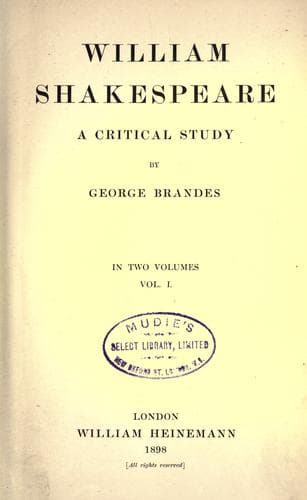
William Shakespeare: A Critical StudyBrandes, Georg
General
William Shakespeare: A Critical Study
Brandes, Georg
Shakespeare, William, 1564-1616 -- Criticism and interpretation
The difference between Jonson's and Shakespeare's method is not that
Jonson pedantically avoids the anachronisms which swarm in _Julius
Cæsar_. In both plays, for instance, watches are spoken of.[1] But Ben,
on occasion, can paint a scene of Roman life with as much accuracy
as we find in a picture by Alma Tadema or a novel by Flaubert. For
example, when he depicts an act of worship and sacrifice in the
Sacellum or private chapel of Sejanus's house (v. 4), every detail of
the ceremonial is correct. After the Herald (Præco) has uttered the
formula, "Be all profane far hence," and horn and flute players have
performed their liturgical music, the priest (Flamen) exhorts all to
appear with "pure hands, pure vestments, and pure minds;" his acolytes
intone the complementary responses; and while the trumpets are again
sounded, he takes honey from the altar with his finger, tastes it, and
gives it to the others to taste; goes through the same process with
the milk in an earthen vessel; and then sprinkles milk over the altar,
"kindleth his gums," and goes with the censer round the altar, upon
which he ultimately places it, dropping "branches of poppy" upon the
smouldering incense. In justification of these traits, Jonson gives no
fewer than thirteen footnotes, in which passages are cited from a very
wide range of Latin authors. Kalisch has counted the notes appended to
this play, and finds 291 in all. The ceremonial is here employed to
introduce a scene in which "great Mother Fortune," to whom the libation
is made, averts her face from Sejanus, and thereby portends his fall;
whereupon, in an access of fury, he overturns her statue and altar.
Another scene, constructed with quite as much learning, and far more
able and remarkable, is that which opens the second Act. Livia's
physician, Eudemus, has been suborned by Sejanus to procure him a
meeting with the princess, and, moreover, to concoct a potent poison
for her husband. In the act of assisting his mistress to rouge her
cheek, and recommending her an effective "dentrifice" and a "prepared
pomatum to smooth the skin," he answers her casual questions as to who
is to present the poisoned cup to Drusus and induce him to drink it.
Here, again, Ben Jonson's mastery of detail displays itself. Eudemus's
remark, for example, that the "ceruse" on Livia's cheeks has faded in
the sun, is supported by a reference to an epigram of Martial, from
which it appears that this cosmetic was injured by heat. But here all
these details are merged in the potent general impression produced by
the dispassionate and business-like calmness with which the impending
murder is arranged in the intervals of a disquisition upon those
devices of the toilet which are to enchain the contriver of the crime.
Public-domain text, read in full here on John Shaqi.
Reviews
Reviews
No reviews yet
Be the first to share your thoughts on this work.
Elsewhere in the archive
Join the Discussion
Join the discussion
Sign in to leave a comment or review.
Sign InorCreate an account