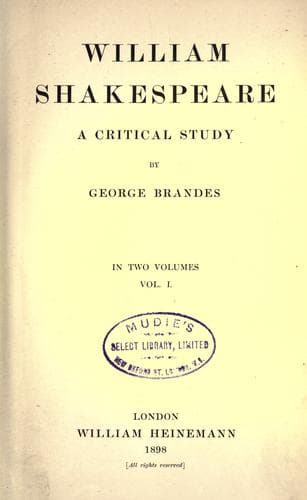
William Shakespeare: A Critical StudyBrandes, Georg
General
William Shakespeare: A Critical Study
Brandes, Georg
Shakespeare, William, 1564-1616 -- Criticism and interpretation
Of this greatness Jonson had probably no deep realisation. It
is surprising enough to note that the scholars and poets of the
Renaissance, in so far as they took sides in the old strife between
Cæsar and Pompey, were all on Pompey's side. Even in the seventeenth
century, in France, under a despotism more absolute than Cæsar's, the
men who were familiar with antique history, and who, for the rest, vied
with each other in loyalty and king-worship, were unanimously opposed
to Cæsar. Strange as it may seem, it is not until our century, with
its hostility to despotism and its continuous advance in the direction
of democracy, that Cæsar's genius has been fully appreciated, and the
benefits his life conferred on humanity have been thoroughly understood.
The personal relation between Ben Jonson and Shakespeare is not to this
day quite clearly ascertained. It was for long regarded as distinctly
hostile, no one doubting that Jonson, during his great rival's
lifetime, cherished an obstinate jealousy towards him. More recently,
Jonson's admirers have argued with warmth that cruel injustice has been
done him in this respect. So far as we can now judge, it appears that
Jonson honestly recognised and admired Shakespeare's great qualities,
but at the same time felt a displeasure he never could quite conquer
at seeing him so much more popular as a dramatist, and--as was only
natural--regarded his own tendencies in art as truer and better
justified.
In the preface to _Sejanus_ (edition of 1605) Jonson uses an expression
which, as the piece was acted by Shakespeare's company, and Shakespeare
himself appeared in it, was long interpreted as referring to him.
Jonson writes:--
"Lastly, I would inform you that this book, in all numbers,
is not the same with that which was acted on the public
stage, wherein a second pen had good share; in place of
which, I have rather chosen to put weaker, and, no doubt,
less pleasing, of mine own, than to defraud so happy a
genius of his right by my loathed usurpation."
Public-domain text, read in full here on John Shaqi.
Reviews
Reviews
No reviews yet
Be the first to share your thoughts on this work.
Elsewhere in the archive
Join the Discussion
Join the discussion
Sign in to leave a comment or review.
Sign InorCreate an account