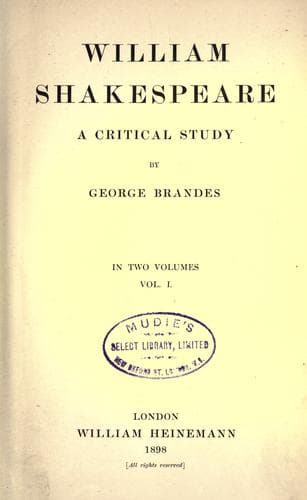
William Shakespeare: A Critical StudyBrandes, Georg
General
William Shakespeare: A Critical Study
Brandes, Georg
Shakespeare, William, 1564-1616 -- Criticism and interpretation
The words "so happy a genius," in particular, together with the
other circumstances, have directed the thoughts of commentators to
Shakespeare. Mr. Brinsley Nicholson, however (in the _Academy_, Nov.
14th, 1874), has shown it to be far more probable that the person
alluded to is not Shakespeare, but a very inferior poet, Samuel
Sheppard. The marked politeness of Jonson's expressions may be due to
his having inflicted on his collaborator a considerable disappointment,
almost an insult, by omitting his portion of the work, and at the same
time excluding his name from the title-page. It seems, at any rate,
that Samuel Sheppard felt wounded by this proceeding, since, more
than forty years later, he claimed for himself the honour of having
collaborated in _Sejanus_, in a verse which is ostensibly a panegyric
on Jonson.[2] Symonds, so late as 1888, nevertheless maintains in his
_Ben Jonson_ that the preface most probably refers to Shakespeare; but
he does not refute or even mention Nicholson's carefully-marshalled
argument.
It is not, however, of great importance to decide whether a compliment
in one of Jonson's prefaces is or is not addressed to Shakespeare,
since we have ample evidence in the warm eulogy and mild criticism
in his _Discoveries_, and in the enthusiastic poem prefixed to the
First Folio, that the crusty Ben (who, moreover, is said to have been
Shakespeare's boon companion on his last convivial evening) regarded
him with the warmest feelings, at least towards the close of his life
and after his death.
This does not exclude the probability that Jonson's radically different
literary ideals may have led him to make incidental and sometimes
rather tart allusions to what appeared to him weak or mistaken in
Shakespeare's work.
There is no foundation for the theory which has sometimes been
advanced, that the passage in _The Poetaster_ ridiculing Crispinus's
coat of arms is an allusion to Shakespeare. It is beyond all doubt
that the figure of Crispinus was exclusively intended for Marston; he
himself, at any rate, did not for a moment doubt it. For the rest,
Jonson's ascertained or conjectured side-glances at Shakespeare are
these:--
In the prologue to _Every Man in his Humour_, which can scarcely have
been spoken when the play was performed by the Lord Chamberlain's
company, not only is realistic art proclaimed the true art, in
opposition to the romanticism which prevailed on the Shakespearian
stage, but a quite definite attack is made on those who
"With three rusty swords,
And help of some few foot and half-foot words,
Fight over York and Lancaster's long jars."
And this is followed by a really biting criticism of the works of other
playwrights, concluding--
"There's hope left then,
You, that have so graced monsters, may like men."
Public-domain text, read in full here on John Shaqi.
Reviews
Reviews
No reviews yet
Be the first to share your thoughts on this work.
Elsewhere in the archive
Join the Discussion
Join the discussion
Sign in to leave a comment or review.
Sign InorCreate an account