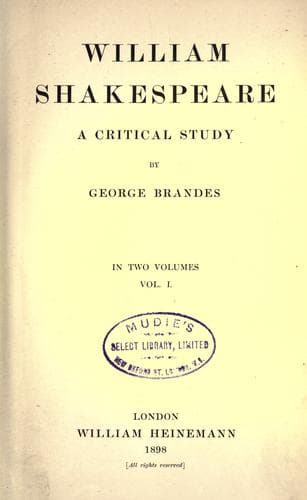
William Shakespeare: A Critical StudyBrandes, Georg
General
William Shakespeare: A Critical Study
Brandes, Georg
Shakespeare, William, 1564-1616 -- Criticism and interpretation
The legend first appears in Saxo Grammaticus. Fengo murders his
brave brother Horvendil, and marries his widow Gerutha (Gertrude).
Horvendil's son, Amleth, determines to disarm Fengo's malevolence
by feigning madness. In order to test whether he is really mad, a
beautiful girl is thrown in his way, who is to note whether, in his
passion for her, he still maintains the appearance of madness. But a
foster-brother and friend of Amleth's reveals the plot to him; the
girl, too, has an old affection for him; and nothing is discovered.
Here lie the germs of Ophelia and Horatio.
With regard to Amleth's mad talk, it is explained that, having a
conscientious objection to lying, he so contorted his sayings that,
though he always said what he meant, people could not discover
whether he meant what he said, or himself understood it--an account
of the matter which applies quite as well to the dark sayings of the
Shakespearian Hamlet as to the naïve riddling of the Jutish Amleth.
Polonius, too, is here already indicated--especially the scene in which
he plays eavesdropper to Hamlet's conversation with his mother. One of
the King's friends (_præsumtione quam solertia abundantior_) proposes
that some one shall conceal himself in the Queen's chamber. Amleth runs
his sword through him and throws the dismembered body to the pigs, as
Hamlet in the play drags the body out with him. Then ensues Amleth's
speech of reproach to his mother, of which not a little is retained
even in Shakespeare:--
"Think'st thou, woman, that these hypocritical tears can
cleanse thee of shame, thee, who like a wanton hast cast
thyself into the arms of the vilest of nithings, hast
incestuously embraced thy husband's murderer, and basely
flatterest and fawnest upon the man who has made thy son
fatherless! What manner of creature doest thou resemble? Not
a woman, but a dumb beast who couples at random."
Fengo resolves to send Amleth to meet his death in England, and
despatches him thither with two attendants, to whom Shakespeare, as
we know, has given the names of Rosencrantz and Guildenstern--the
names of two Danish noblemen whose signatures have been found in close
juxtaposition (with the date 1577) in an album which probably belonged
to a Duke of Würtemberg. They were colleagues in the Council of Regency
during the minority of Christian IV. These attendants (according to
Saxo) had rune-staves with them, on which Amleth altered the runes, as
in the play he re-writes the letters.
Public-domain text, read in full here on John Shaqi.
Reviews
Reviews
No reviews yet
Be the first to share your thoughts on this work.
Elsewhere in the archive
Join the Discussion
Join the discussion
Sign in to leave a comment or review.
Sign InorCreate an account