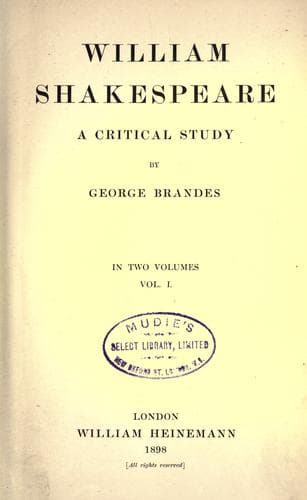
William Shakespeare: A Critical StudyBrandes, Georg
General
William Shakespeare: A Critical Study
Brandes, Georg
Shakespeare, William, 1564-1616 -- Criticism and interpretation
"So His, that Divine Plautus equalled,
Whose Commick vain Menander nere could hit,
Whose tragic sceans shal be with wonder Read
By after ages, for unto his wit
My selfe gave personal ayd, _I_ dictated
To him when as _Sejanus_ fall he writ,
And yet on earth some foolish sots there bee
That dare make Randolph his Rival in degree."
[3] "If there be never a servant-monster in the fair, who can help
it, he says, nor a nest of antiques? He is loth to make Nature afraid
in his plays, like those that beget tales, tempests, and such-like
drolleries."
XI
_HAMLET: ITS ANTECEDENTS IN FICTION, HISTORY, AND DRAMA_
Many and various emotions crowded upon Shakespeare's mind in the year
1601. In its early months Essex and Southampton were condemned. At
exactly the same time there occurs the crisis in the relations of
Pembroke and Shakespeare with the Dark Lady. Finally, in the early
autumn, Shakespeare suffered a loss which he must have felt deeply. The
Stratford register of burials for 1601 contains this line--
_Septemb._ 8. Mr. _Johannes Shakespeare_.
He lost his father, his earliest friend and guardian, whose honour and
reputation lay so near to his heart. The father probably lived with his
son's family in the handsome New Place, which Shakespeare had bought
four years before. He had doubtless brought up the two girls Susannah
and Judith; he had doubtless sat by the death-bed of the little Hamnet.
Now he was no more. All the years of his youth, spent at his father's
side, revived in Shakespeare's mind, memories flocked in upon him, the
fundamental relation between son and father preoccupied his thoughts,
and he fell to brooding over filial love and filial reverence.
In the same year _Hamlet_ began to take shape in Shakespeare's
imagination.
_Hamlet_ has given the name of Denmark a world-wide renown. Of all
Danish men, there is only one who can be called famous on the largest
scale; only one with whom the thoughts of men are for ever busied in
Europe, America, Australia, aye, even in Asia and Africa, wherever
European culture has made its way; and this one never existed, at any
rate in the form in which he has become known to the world. Denmark
has produced several men of note--Tycho Brahe, Thorvaldsen, and Hans
Christian Andersen--but none of them has attained a hundredth part of
Hamlet's fame. The _Hamlet_ literature is comparable in extent to the
literature of one of the smaller European peoples--the Slovaks, for
instance.
As it is interesting to follow with the eye the process by which a
block of marble slowly assumes human form, so it is interesting to
observe how the _Hamlet_ theme gradually acquires its Shakespearian
character.
Public-domain text, read in full here on John Shaqi.
Reviews
Reviews
No reviews yet
Be the first to share your thoughts on this work.
Elsewhere in the archive
Join the Discussion
Join the discussion
Sign in to leave a comment or review.
Sign InorCreate an account