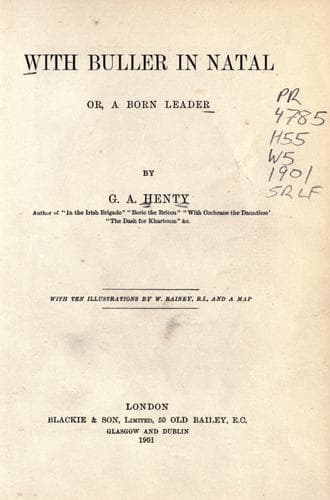
With Buller in Natal, Or, a Born LeaderHenty, G. A. (George Alfred)
General
With Buller in Natal, Or, a Born Leader
Henty, G. A. (George Alfred)
South African War, 1899-1902 -- Fiction
The 22nd was comparatively quiet. The situation was not improving. Five
miles of rough ground had been won in as many days' fighting, but the
force was becoming lengthened out and the line weaker. Lyttleton's
force had to guard the line from Potgieter's Drift to Warren's right
against any attempt of the Boers to cut the lines of communication.
Woodgate was similarly employed in keeping the line from Trichardt's
Drift to Warren's left, and it became increasingly evident that not
much further progress could be made until the left of the advance was
protected by the establishment of guns on the great hill. It was then,
on the 23rd, decided that Woodgate's brigade should assault Spion Hop
that night. It was known that it was not strongly held.
Starting at six o'clock, the column made its way slowly and with vast
difficulty up the ascent. This was everywhere rugged and rocky, and in
many places so precipitous that men had to be pushed or pulled up by
their comrades.
Colonel Thorneycroft led the way with a few men, finding out the spots
at which an ascent was practicable, and scouting on either side to
discover if Boers were hidden; behind him followed Woodgate leading his
men. He was in bad health and quite unfit for such a climb, but in
spite of remonstrances he had insisted upon going, although he was
obliged to be assisted at the more difficult places. The distance was
not more than six miles, but it was not until nearly ten hours after
starting that the summit was gained. The hilltop was enveloped in mist,
and they were unseen until the Lancashire Fusiliers, who were leading,
were within fifty yards of the top. Then a Boer challenged them, and
directly fired his rifle. Almost instantly a dozen of his comrades
joined him, and bringing their magazines into play opened a fierce
fusillade. But the aim was hurried, they could scarce see their foes,
and the Lancashire men, cheering loudly, rushed up to the crest without
loss.
The Boers did not await their arrival; only one of them was bayoneted
before he turned to fly, and but two or three were overtaken by the
eager soldiers. As soon as the Boers had gone, the troops set to work
to construct breastworks to hold the spot they had gained against any
attempts of the Boers to recapture. The ground was too rocky for
digging, and the stones that were scattered thickly about were used for
the purpose; but long before the breastwork could be completed a
dropping fire was opened by the enemy. The morning was gray and misty,
and the clouds hung heavily on the hilltop. As these cleared off
slowly, it could be seen that the position was less favourable than it
had seemed, for the flat crest extended some distance beyond the point
they had entrenched, and from the rocks and low ridges a hot fire broke
out. Before the mist cleared off, the Boers had crept up in
considerable force, and were, it was evident, preparing to retake the
position that had been wrested from them.
Public-domain text, read in full here on John Shaqi.
Reviews
Reviews
No reviews yet
Be the first to share your thoughts on this work.
Elsewhere in the archive
Join the Discussion
Join the discussion
Sign in to leave a comment or review.
Sign InorCreate an account