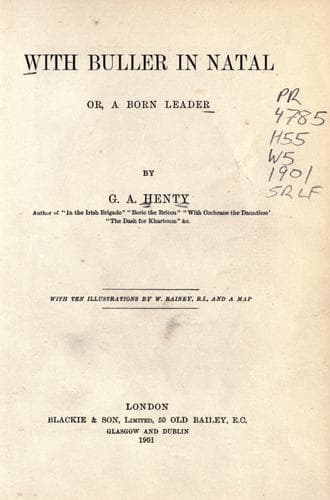
With Buller in Natal, Or, a Born LeaderHenty, G. A. (George Alfred)
General
With Buller in Natal, Or, a Born Leader
Henty, G. A. (George Alfred)
South African War, 1899-1902 -- Fiction
By six o'clock the scattered fire had grown into a continuous roar, the
Boers occupying not only the nek itself, but the flanks of the hill.
Several times our men made rushes to endeavour to clear off the foe,
but these proved too costly, and they were now lying or kneeling behind
the unfinished barricade. In a very short time the clouds had lifted
sufficiently for the Boer artillery to discover the exact position, and
from the hills on three sides a terrible fire of shot and shell, from
cannon great and small and machine-guns, rained upon them. Again and
again parties of men started to their feet and dashed forward to drive
the hidden Boers facing them from their hiding-places. Sometimes they
succeeded for a time, but their numbers thinned so fast that the
survivors were forced to fall back again. To add to the horror of the
situation, the shot from our own guns also fell among the defenders,
the officers commanding the batteries not having been informed of the
intention to occupy the hill, and knowing nothing of the situation.
Scores of men were killed or wounded, but the position was held
unflinchingly.
At ten o'clock General Woodgate was mortally wounded by the fragment of
a shell that struck him in the eye, and Colonel Crofton took the
command. He at once flashed a message to General Warren, stating that
Woodgate was killed, and that reinforcements must be sent at once;
General Coke was therefore ordered to take the Middlesex and Dorset
regiments, and assume the command. Immediately afterwards Warren
received an order from General Buller to appoint Lieutenant-colonel
Thorneycroft, who was colonel of a colonial force, to take the command.
It was now hoped that all was well there. Unfortunately, neither Buller
nor Warren was able to give his undivided attention to the struggle on
the mountain, for Lyttleton's brigade had advanced before daybreak
against the eastern slopes of the hills running north from Spion Kop.
They advanced briskly, their Maxims clearing out the Boers, from whose
fire they suffered but little; but they sustained some loss from the
shell fire from Mount Alice, the sailors having been as uninformed of
the advance the brigade were to make as they were of the capture of
Spion Kop. The Scottish Rifles and the 3rd King's Royal Rifles pushed
on rapidly and gained the spur farthest north. Had there been guns on
Spion Kop the object of the movement would have been attained, and the
advance by direct road on Ladysmith have become a possibility; but no
guns had reached the summit, and the troops there were so far from
being able to render assistance that they were with difficulty
maintaining their desperate resistance. As the two rifle regiments were
therefore exposed to a concentrated fire from the Boer batteries, and
were without support, they were directed to withdraw, but the order had
to be repeated three times before it was obeyed. The fire slackened at
this point to some extent in the afternoon, no farther advance being
Public-domain text, read in full here on John Shaqi.
Reviews
Reviews
No reviews yet
Be the first to share your thoughts on this work.
Elsewhere in the archive
Join the Discussion
Join the discussion
Sign in to leave a comment or review.
Sign InorCreate an account