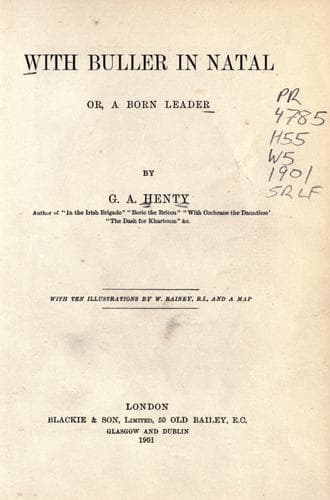
With Buller in Natal, Or, a Born LeaderHenty, G. A. (George Alfred)
General
With Buller in Natal, Or, a Born Leader
Henty, G. A. (George Alfred)
South African War, 1899-1902 -- Fiction
General Buller was the last man to retire as long as there was a hope
of success. He knew that not only at home, but all over the civilized
world, men were anxiously awaiting the news of his second attempt to
relieve Ladysmith, and it must have been hard indeed for him to have to
acknowledge a second reverse; but in spite of this he sternly
determined to fall back. The movement was admirably executed; every
horse, waggon, gun, and soldier was taken safely across the Tugela
without hindrance by the Boers, a fact that showed how deeply they had
been impressed with the valour of our soldiers. Sullenly and angrily
the troops marched away. Had they had their will they would have hurled
themselves against the Boer entrenchments until the last man had
fallen. To them the necessities of the situation were as nothing; to
retreat seemed an acknowledgment that they had been beaten, a feeling
that is seldom entertained by British soldiers. Their losses had been
heavy, but there were still enough of them, they thought, for the work
they had to do, and it was with a deep feeling of unmerited humiliation
that they received the order to retire.
The feeling, however, was not of long endurance, for two days later,
when they had settled down in camp near the Tugela and round Spearman's
Farm, the general rode through the lines, congratulating the troops on
the valour they had displayed, and promising them that ere long they
would be in Ladysmith.
"I shall be heartily glad when we are there," Chris said when he heard
what the general had promised, "not only for the sake of the town, but
for our own. We are really doing no good here. It is hateful to look on
when other fellows are fighting so desperately. If it were not that the
orders were strict against the mounted Colonial corps going out over
the country, to clear the scattered Boers out, we might be doing useful
service; and as soon as Ladysmith is relieved--that is to say, if we
can hold out till we get there--I should certainly vote that we come
back here instead of staying with the army, and go on again on our own
account."
"I quite agree with you," Carmichael said. "Still, it is something to
have seen two big fights."
"Yes," Brown grumbled, "but if we tell anybody that we were there,
naturally the first question will be, 'What part did you take in it',
and we shall have to own that we took no part at all, and only looked
on at a distance at the other fellows fighting. I call it sickening."
"Well, never mind, Brown," Chris said; "after all, during this
business, we have killed twice our own number of Boers at the least,
and if everyone had done as much the Boers would be pretty well
extinct."
"Yes, there is certainly something in that," Brown admitted, "but if we
had been allowed to scout on our own account it would be hard if we had
not killed twice as many more by this time."
Public-domain text, read in full here on John Shaqi.
Reviews
Reviews
No reviews yet
Be the first to share your thoughts on this work.
Elsewhere in the archive
Join the Discussion
Join the discussion
Sign in to leave a comment or review.
Sign InorCreate an account