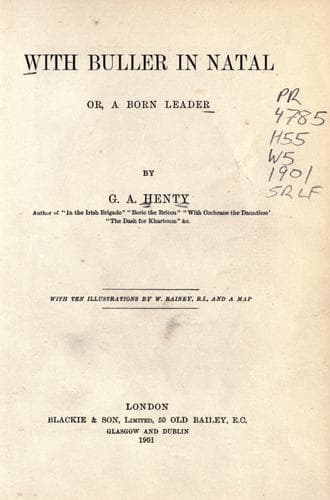
With Buller in Natal, Or, a Born LeaderHenty, G. A. (George Alfred)
General
With Buller in Natal, Or, a Born Leader
Henty, G. A. (George Alfred)
South African War, 1899-1902 -- Fiction
attempted, but it raged as hotly as ever on the summit of Spion Kop.
As neither General Buller nor Warren had come up to see the state of
things on the all-important position of Spion Kop, General Coke went
down in the evening to explain the situation. He stated that unless the
artillery could silence the enemy's guns the troops could not support
another day's shelling. In the evening two naval twelve-pounders, the
R. A. mountain battery, and one thousand two hundred men as reliefs,
started to ascend the hill and to strengthen the entrenchments. On the
way up they met Colonel Thorneycroft and the rest of the force coming
down, that officer, who had displayed splendid gallantry throughout the
day, having decided on his own responsibility that the position could
not be longer held. Strangely enough, the news of the retirement was
not communicated to General Buller, who, after reporting in his
despatches written next morning that Spion Kop was firmly held, was
riding to the front when he for the first time learned the news.
Altogether it was a day of strange blunders, redeemed only by the
splendid bravery of the troops engaged. The news came as a heavy blow
to the army, but it was supposed that a fresh attempt would be made to
capture the position by ascending the northern spurs that had been
carried and held for a time by the two rifle battalions. But while
soldiers think only of the chances of battle, and burn to engage the
enemy, a feeling only accentuated by previous failures, generals in
command have to take other matters into consideration. They may feel
that they may conquer in the next fight, but what is to follow? In this
case the chances of success would be smaller than before, the loss more
serious, for the Boers from all parts had united to oppose us. Many of
the cannon had been brought over from the positions from which
Ladysmith was bombarded. The advantage of surprise gained by the long
march from Chieveley had been lost; more serious still was it that a
large proportion of the provisions, brought at the cost of so much
labour and exhaustion of the transport animals, was consumed, and what
remained would be insufficient had fresh battles to be fought to
capture the positions, one behind another, held by the Boers.
Public-domain text, read in full here on John Shaqi.
Reviews
Reviews
No reviews yet
Be the first to share your thoughts on this work.
Elsewhere in the archive
Join the Discussion
Join the discussion
Sign in to leave a comment or review.
Sign InorCreate an account