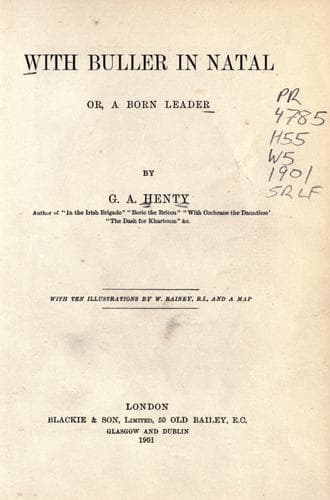
With Buller in Natal, Or, a Born LeaderHenty, G. A. (George Alfred)
General
With Buller in Natal, Or, a Born Leader
Henty, G. A. (George Alfred)
South African War, 1899-1902 -- Fiction
The next morning Thorneycroft's regiment crossed, and, moving to the
left, seized the kopjes facing Grobler's Kloof; the Boers, still
suffering from the effect of their unexpected reverses, offered no
resistance, but, abandoning all their camps, trenches, and redoubts,
retired at once to the hill. The Scouts had followed Thorneycroft's
Horse in support, and now, placing their horses under shelter in the
abandoned entrenchments, prepared to act as infantry should the Boers
take the offensive. This, however, they showed no intention of doing,
and in the afternoon the troops who had crossed were able to examine
the deserted camps. They presented very much the same appearance as
those on Monte Cristo and Hlangwane. Many of them appeared to have been
occupied by men of a better position, as many articles of luxury,
choicer food, wearing apparel, newspapers, Bibles, fruit, and other
signs of comfort littered the places; but even here dirt had reigned
supreme. Although they must have been inhabited for a long time, it
could be seen that no attempts had been made to clear away the refuse,
or to make them in any degree tidy. As was natural, the effect of the
heat of the sun on scraps of food, vegetables, and refuse of all kinds
caused a sickening stench, and the soldiers spent as short a time as
possible over their investigations. One article which would have been
found in a British camp was altogether absent from those of the enemy,
and it was a joke among our troops that the only piece of soap ever
captured was found in the pocket of a dead Boer, and that its wrapper
was still unopened.
The strength of the position was, however, even more surprising than
the state of filth; every trench was enfiladed by another, great
boulders were connected by walls of massive construction, this being
specially the case where guns had been placed in position. Colenso
itself had been in a similar manner rendered almost impregnable to a
frontal attack, and could hardly have been captured by an assaulting
force until Hlangwane had been taken.
The hills beyond the railway still covered the road bridge by their
fire, and had the troops marched across it they would have suffered
severely. Accordingly a pontoon train was sent through an opening in
the Hlangwane range, and a bridge thrown over the Tugela north of Fort
Wylie. The Dorsets, Middlesex, and Somersets crossed at once, and,
ascending the kopjes, extended their line south until they were in
communication with Thorneycroft's men, holding therefore the railway
line along the river bank nearly half the distance between Colenso and
Pieters station. Other regiments and artillery followed.
Public-domain text, read in full here on John Shaqi.
Reviews
Reviews
No reviews yet
Be the first to share your thoughts on this work.
Elsewhere in the archive
Join the Discussion
Join the discussion
Sign in to leave a comment or review.
Sign InorCreate an account