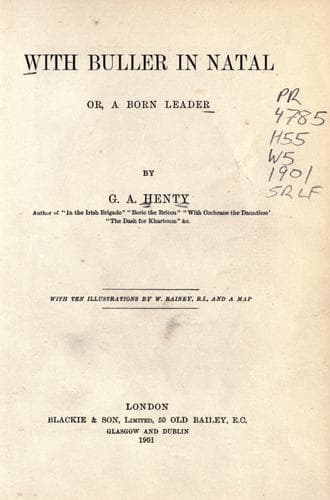
With Buller in Natal, Or, a Born LeaderHenty, G. A. (George Alfred)
General
With Buller in Natal, Or, a Born Leader
Henty, G. A. (George Alfred)
South African War, 1899-1902 -- Fiction
It was now six days since the advance had commenced, and for the past
four fighting had been almost continuous. On Wednesday the three
regiments advanced towards Grobler's Hill in order to ascertain what
force was occupying it. They met with no opposition until they reached
the lower slopes, nor could any Boers be seen moving. Then suddenly a
heavy fire broke out from the boulders which covered the whole face of
the hill, and afforded such perfect shelter that it had not been
considered necessary to form entrenchments. As only a reconnaissance,
and not an attack, had been ordered, the force retired, the Somersets,
who were the leading regiment, having nearly a hundred casualties. The
other regiments had as many more between them. The next day a
continuous fire from all the points held by the Boers showed that large
reinforcements had reached them. The Lancashire Brigade, under Colonel
Wynne, started at two o'clock that afternoon to carry the kopjes up the
Brook Spruit, which ran in the rear of Grobler's Kloof. The Royal
Lancasters led the way, but as soon as they left the shelter of the
ridges by the side of the railway they were exposed to a terrible fire,
both in front and from Grobler's Kloof. The artillery on Hlangwane, and
those still on the plain, endeavoured to silence the enemy's guns, but
though they poured numbers of lyddite and shrapnel shells among them
they were unable to do so. The Lancasters advanced with the greatest
coolness up the spruit, followed by the South Lancasters. As they
pressed forward they were met by a heavy rifle fire both from the
kopjes in front and on the left. The Boers stuck to the hill until the
Lancasters were within a hundred yards, then most of them slunk off.
Not knowing this, the Lancasters lay under shelter for a few minutes
until their ammunition pouches had been replenished, then, being joined
by the South Lancasters and King's Royal Rifles, they rushed to the
crest.
For the past two days the Dublin Fusiliers had been lying near Colenso.
They had suffered very heavily in the first attack at Potgieter's
Drift, but they now volunteered to take Grobler's Hill; and this, aided
with the fire of the artillery and Colonel Wynne's brigade, they did in
gallant style, the Boers being evidently nervous that they might find
their retreat cut off should the Lancasters advance farther up the
spruit.
On Friday afternoon the Irish Brigade advanced along the line, and then
turned off towards Railway Hill, a steep jagged eminence almost
triangular in shape, with one angle pointing towards the river. The
sides were broken with sharp ledges covered with boulders. The railway
passed through this, separating the last jagged ledge from the higher
portion of the hill, which rises almost precipitously. Running back
several hundred yards at the base of this line was a dip full of thorn
trees. This deep winds round the rear of the hill, and here there was a
large Boer Camp.
Public-domain text, read in full here on John Shaqi.
Reviews
Reviews
No reviews yet
Be the first to share your thoughts on this work.
Elsewhere in the archive
Join the Discussion
Join the discussion
Sign in to leave a comment or review.
Sign InorCreate an account