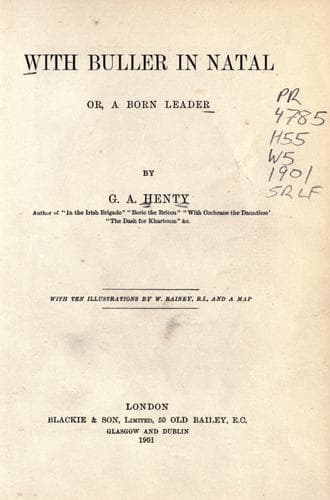
With Buller in Natal, Or, a Born LeaderHenty, G. A. (George Alfred)
General
With Buller in Natal, Or, a Born Leader
Henty, G. A. (George Alfred)
South African War, 1899-1902 -- Fiction
"I hear," Chris said, "that General Buller is going to make a formal
entry here on Saturday, and that the garrison will line the road. I
don't know whether Dundonald's brigade will have anything to do with
it; but if he does, Brookfield will certainly like to make a good show.
So until that is over I won't do anything about the horses."
On the day appointed the garrison turned out to receive the general and
the troops who had struggled so long and gallantly to effect their
rescue, and the Devons, Gloucesters, Rifles, Leicesters, Manchesters,
Liverpools, sappers, artillerymen, and the Naval Brigade marched out
from their camps and lined the road as far as the railway-station,
where the remnant of the cavalry brigade were drawn up. At eleven
o'clock Sir George White, Sir Archibald Hunter, and Colonel Duff and
his staff rode up and took their place in the front of the shattered
tower of the town-hall. Here, too, Captain Lambton and many other
officers took their place. Not far from these were a score of civilians
who had not shared in the general exodus that had been going on from
the day on which the town was relieved, but had delayed their departure
in order to witness the historical scene. At last the head of the
column was seen approaching. Lord Dundonald's men had ridden down on
the previous day, and the mounted Colonial Volunteers had now the
honour of forming the general's escort. They led the way, and after
them came General Buller with his escort. The Dublin Fusiliers were
placed at the head of the column in acknowledgment of the gallantry
displayed by them in every fight; then came the men of Warren's,
Lyttleton's, and Barton's brigades, with their artillery. Great indeed
was the contrast between the sturdy, bronzed, and well-fed soldiers who
cheered as they marched, many of them carrying their helmets on their
bayonets, and the lines of emaciated men through whom they passed.
These cheered too, but their voices sounded strange and thin, and many,
indeed, were too much overcome by weakness and emotion to be able to
add their voices to the shouts. The enthusiasm of the troops rose to
the highest when they passed a group of women and children, who, with
streaming eyes, greeted them as they passed.
Public-domain text, read in full here on John Shaqi.
Reviews
Reviews
No reviews yet
Be the first to share your thoughts on this work.
Elsewhere in the archive
Join the Discussion
Join the discussion
Sign in to leave a comment or review.
Sign InorCreate an account