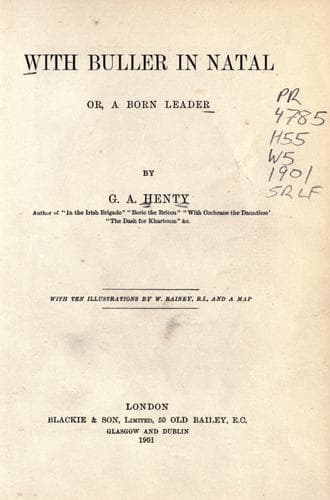
With Buller in Natal, Or, a Born LeaderHenty, G. A. (George Alfred)
General
With Buller in Natal, Or, a Born Leader
Henty, G. A. (George Alfred)
South African War, 1899-1902 -- Fiction
The pipes of the Highlanders and the beating of drums added to the roar
of sound. The contrast between the dress of rescuers and rescued was as
great as their personal appearance. Sir George White's men had of late
had but little work, and had prepared for the occasion to the best of
their power, as if for a review at Aldershot. They had done what they
could. Their khaki suits had been washed and scrubbed until, though
discoloured, they were scrupulously clean. The belts, accoutrements,
and rifles had all been rubbed up and scoured. On the other hand, the
uniforms of regiments that marched in were travel-stained, begrimed
with the dust of battle and the mud of bivouac, until their original
hue had entirely disappeared. They looked as if they had at first been
dragged through thorn bushes and then been given a mud-bath.
Captain Lambton rode forward to meet the sailors of the Terrible with
the guns that had done such service, followed by the howitzers which
had almost equally contributed to the final success of the operations.
He was loudly cheered by the sailors, and the heartiest greetings were
exchanged between him and their officers. Both in attack and defence
the Naval Brigade had performed inestimable services.
Behind the column came a large body of men in civilian dress. Their
appearance was as unkempt as that of the troops, but among these there
was no approach to military order, and yet their heroism had been in no
way inferior to that of the troops. These were the stretcher-bearers,
who had in every fight carried on their work of mercy under the
heaviest fire, and that without the excitement that nerves soldiers to
face danger. Many of them had fallen while so engaged, but this had in
no way unnerved their companions, who had not only carried on the work
during daylight, but had often laboured all night until the last
wounded man had been found and carried down to the hospital. When the
names of the heroes of the force that relieved Ladysmith are recounted
those of the stretcher-bearers are worthy of a place among them.
After the troops had been dismissed and matters had settled down a
little, Chris went over to the camp of the cavalry brigade, and spoke
to the first officer he met. "I have come across, sir," he said, "to
ask if any of you wish to buy remounts. The party to which I belong
have twenty-five horses; they are exceptionally good animals, and cost
us sixty pounds apiece last October. We furnished our own equipment. As
we are all sons of gentlemen at Johannesburg, we did not much mind what
we paid. Anyhow, we are ready to sell them at the price we gave for
them."
"We all want remounts badly enough," the officer said. "Will you come
in with me to the colonel?"
Public-domain text, read in full here on John Shaqi.
Reviews
Reviews
No reviews yet
Be the first to share your thoughts on this work.
Elsewhere in the archive
Join the Discussion
Join the discussion
Sign in to leave a comment or review.
Sign InorCreate an account