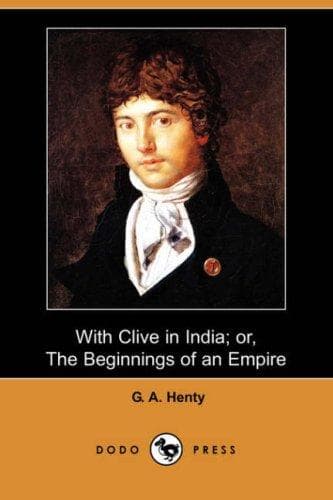
With Clive in India; Or, The Beginnings of an EmpireHenty, G. A. (George Alfred)
History
With Clive in India; Or, The Beginnings of an Empire
Henty, G. A. (George Alfred)
India -- History -- British occupation, 1765-1947 -- Fiction
To show his determination, he despatched fifteen hundred men to
Hoogly, which the English had abandoned after capturing it, with
instructions to help the French if attacked; and he sent a lac of
rupees to Monsieur Renault, to aid him in preparing for his defence.
Clive, unwilling to face a coalition between the French and the nabob,
was in favour of acceding to the nabob's orders. The treaty of
neutrality with the French was drawn up, and would have been signed,
had it not been for the obstinate refusal of Admiral Watson to agree
to it. Between that officer and Clive there had never been any cordial
feeling, and from the time of their first connection, at the siege of
Gheriah, differences of opinion, frequently leading to angry disputes,
had taken place between them. Nor was it strange that this should be
so. Both were brave and gallant men; but while Watson had the
punctilious sense of honor which naturally belongs to an English
gentleman, Clive was wholly unscrupulous as to the means which he
employed to gain his ends.
Between two such men, it is not singular that disagreements arose.
Admiral Watson, impelled by feelings of personal dislike to Clive,
often allowed himself to be carried to unwarrantable lengths. On the
occasion of the capture of Calcutta, he ordered Captain Eyre Coote,
who first entered it, to hold it in the king's name, and to disobey
Clive's orders, although the latter had been granted a commission in
the royal army as lieutenant colonel, and was, moreover, the chief
authority of the Company in all affairs on land. Upon Clive's
asserting himself, Admiral Watson absolutely threatened to open fire
upon his troops. Apparently from a sheer feeling of opposition, he now
opposed the signing of the treaty with the French, and several days
were spent in stormy altercations.
Circumstances occurred, during this time, which strengthened the view
he took, and changed those of Clive and his colleagues of the council.
Just then, the news reached Suraja-u-Dowlah that Delhi had been
captured by the Afghans; and, terrified at the thought that the
victorious northern enemy might next turn their arms against him, he
wrote to Clive, begging him to march to his assistance, and offering a
lac of rupees a month towards the expense of his army.
On the same day that Clive received the letter, he heard that
Commodore James and three ships, with reinforcements from Bombay, had
arrived at the mouth of the Hoogly; and that the Cumberland, with
three hundred troops, which had grounded on her way from Madras, was
now coming up the river.
Almost at the same moment he heard, from Omichund, who had accompanied
the nabob to Moorshedabad, that he had bribed the governor of Hoogly
to offer no opposition to the passage of the troops up the river.
Public-domain text, read in full here on John Shaqi.
Reviews
Reviews
No reviews yet
Be the first to share your thoughts on this work.
Elsewhere in the archive
Join the Discussion
Join the discussion
Sign in to leave a comment or review.
Sign InorCreate an account