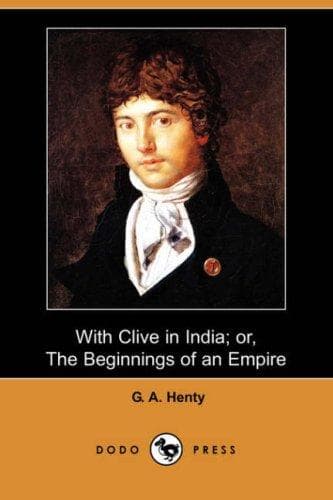
With Clive in India; Or, The Beginnings of an EmpireHenty, G. A. (George Alfred)
History
With Clive in India; Or, The Beginnings of an Empire
Henty, G. A. (George Alfred)
India -- History -- British occupation, 1765-1947 -- Fiction
The rains had now set in, but the English laboured steadily at their
batteries. The French were becoming pressed for provisions, and Lally
turned the whole of the natives remaining in the town, to the number
of fourteen hundred men and women, outside the fortifications. On
their arrival at the English lines they were refused permission to
pass, as Colonel Coote did not wish to relieve the garrison of the
consumption of food caused by them. They returned to the French lines,
and begged to be again received; but they were, by Lally's orders,
fired upon, and several killed.
For seven days the unhappy wretches remained without food, save the
roots they could gather in the fields. Then Colonel Coote, seeing that
Lally was inflexible, allowed them to pass.
On the 10th of November the batteries opened, and every day added to
the strength of the fire upon the town. The fortifications, however,
were strong, and the siege progressed but slowly. On the 30th of
December a tremendous storm burst, and committed the greatest havoc,
both at land and sea. The Newcastle, man-of-war; the Queenborough,
frigate; and the Protector, fire ship were driven ashore and dashed to
pieces; but the crews, with the exception of seven, were saved. The
Duke of Aquitaine, the Sunderland, and the Duke, store ship, were
sunk, and eleven hundred sailors drowned. Most of the other ships were
dismasted.
Chapter 30: Home.
The fire of the batteries increased, and by the 13th of January the
enemy's fire was completely silenced. The provisions in the town were
wholly exhausted, and on the 16th the town surrendered, and the next
morning the English took possession. Three days afterwards Lally was
embarked on board ship, to be taken a prisoner to Madras; and so much
was he hated that the French officers and civilians assembled, and
hissed and hooted him; and, had he not been protected by his guard,
would have torn him to pieces. After his return to France he was tried
for having, by his conduct, caused the loss of the French possessions
in India, and being found guilty of the offence, was beheaded.
At Pondicherry two thousand and seventy-two military prisoners were
taken, and three hundred and eighty-one civilians. Five hundred cannon
and a hundred mortars, fit for service; and immense quantities of
ammunition, arms, and military stores fell into the hands of the
captors.
Pondicherry was handed over to the Company; who, a short time
afterwards, entirely demolished both the fortress and town. This hard
measure was the consequence of a letter which had been intercepted,
from the French government to Lally, ordering him to raze Madras to
the ground, when it fell into his hands.
Public-domain text, read in full here on John Shaqi.
Reviews
Reviews
No reviews yet
Be the first to share your thoughts on this work.
Elsewhere in the archive
Join the Discussion
Join the discussion
Sign in to leave a comment or review.
Sign InorCreate an account