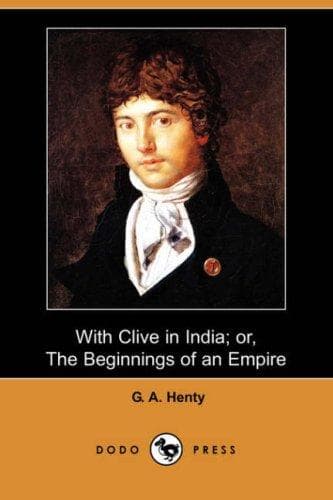
With Clive in India; Or, The Beginnings of an EmpireHenty, G. A. (George Alfred)
History
With Clive in India; Or, The Beginnings of an Empire
Henty, G. A. (George Alfred)
India -- History -- British occupation, 1765-1947 -- Fiction
Charlie, after the siege, in which he had rendered great services,
received from the Company, at Colonel Coote's earnest recommendation,
his promotion to the step of lieutenant colonel; while Peters was
raised to that of major. A fortnight after the fall of Pondicherry,
they returned to Madras, and thence took the first ship for England.
It was now just ten years since they had sailed, and in that time they
had seen Madras and Calcutta rise, from the rank of two trading
stations, in constant danger of destruction by their powerful
neighbours, to that of virtual capitals of great provinces. Not as
yet, indeed, had they openly assumed the sovereignty of these
territories; but Madras was, in fact, the absolute master of the broad
tract of land extending from the foot of the mountains to the sea,
from Cape Comorin to Bengal; while Calcutta was master of Bengal and
Oressa, and her power already threatened to extend itself as far as
Delhi. The conquest of these vast tracts of country had been achieved
by mere handfuls of men, and by a display of heroic valour and
constancy scarce to be rivalled in the history of the world.
The voyage was a pleasant one, and was, for the times, quick,
occupying only five months. But to the young men, longing for home
after so long an absence, it seemed tedious in the extreme.
Tim and Hossein were well content with their quiet, easy life, after
their long toils. They had nothing whatever to do, except that they
insisted upon waiting upon Charlie and Peters, at meals. The ship
carried a large number of sick and wounded officers and men, and as
these gained health and strength, the life on board ship became
livelier, and more jovial. Singing and cards occupied the evenings,
while in the daytime they played quoits, rings of rope being used for
that purpose, and other games with which passengers usually wile away
the monotony of long voyages.
It was late in June when the Madras sailed up the Thames; and, as soon
as she came to anchor, the two officers and their followers landed.
The din and bustle of the streets seemed almost as strange, to
Charlie, as they had done when he came up a boy, from Yarmouth.
Hossein was astonished at the multitude of white people, and inquired
of Charlie why, when there were so many men, England had sent so few
soldiers to fight for her in India; and for once, Charlie was unable
to give a satisfactory reply.
"It does seem strange," he said to Peters, "that when such mighty
interests were at stake, a body of even ten thousand troops could not
have been raised, and sent out. Such a force would have decided the
struggle at once; and in three months the great possessions, which
have cost the Company twelve years' war, would have been at their
feet. It would not have cost them more; indeed, nothing like as much
as it now has done, nor one tithe of the loss in life. Somehow,
England always seems to make war in driblets."
Public-domain text, read in full here on John Shaqi.
Reviews
Reviews
No reviews yet
Be the first to share your thoughts on this work.
Elsewhere in the archive
Join the Discussion
Join the discussion
Sign in to leave a comment or review.
Sign InorCreate an account