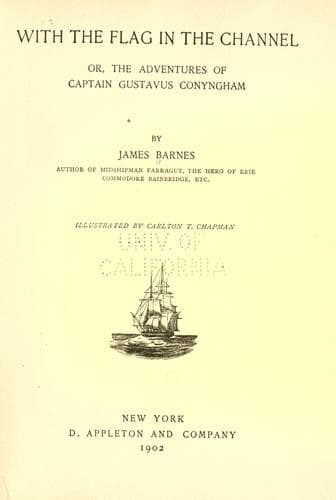
With the Flag in the Channel; or, The Adventures of Captain Gustavus ConynghamBarnes, James
History
With the Flag in the Channel; or, The Adventures of Captain Gustavus Conyngham
Barnes, James
United States -- History -- Revolution, 1775-1783 -- Juvenile fiction
The English sailors did not seem to be in the least suspicious, and the
Americans fell in readily with the apparent position of affairs. But as
one after another was called to the galley on some pretext, they soon
were cognizant of the captain’s plot.
The English sailors had discarded their cutlasses, and were grouped
with the others about the mess-kits that had been brought up on deck,
when suddenly the captain appeared alone from the cabin. Mr. Jarvis
joined him, and both stepped quickly forward toward the forecastle.
The men, seeing the two officers approach, arose to their feet. The
English sailors glanced suspiciously about them, and a glance was
enough to convince them that they were trapped. At the elbow of each
man stood one of their whilom hosts. A few of the Americans were
armed with pistols, and the negro cook with a big carving-knife stood
over the pile of cutlasses that they had left on the deck by the main
fife-rail.
“Now, men,” said Conyngham quietly, “we want no cutting, slashing, or
shooting, and you’re our prisoners. But don’t be afraid,” he added,
as he saw a look of fear come into the Englishmen’s eyes. “We are no
pirates. You’ll get to Portsmouth all right, where you can join your
ship. You’ll have a good joke to tell them of the Yankee-Irish trick
that was played on you. Take the prisoners below, Mr. Corkin,” he
continued, addressing the boatswain. “Put them in the hold and mount a
guard over them.--And now, Socrates,” he added, turning to the grinning
cook, “we’ll have our breakfast in the cabin.”
The English lieutenant, released from his bonds, sat at first in sulky
silence and would not even touch a bit of the savory rasher that
Socrates placed before him. When he went on deck later at Captain
Conyngham’s invitation he looked off to the eastward. The Minerva,
almost hull down, was holding a course toward the French coast. At the
masthead of the Charming Peggy fluttered the English flag, and in the
distance to the westward, plain above the horizon, rose the English
shores.
“We’ll go in a little closer, Mr. Holden,” said Captain Conyngham, “and
then we’ll part company, sir.”
He turned to the first mate.
“Mr. Jarvis,” he went on, “prepare to lower the cutter; put in a
breaker of water, two bags of biscuit, and a bottle of port.”
After half an hour’s more sailing the brig was hove to and the crew,
with Higgins and McCarthy now freed from their irons, pushed out from
the brig’s side. In the stern sheets sat the lieutenant disconsolately.
He turned to watch the brig as she came about and headed off shore. At
that moment down came the English flag and the Spanish took its place.
And it was just at this minute that Captain Conyngham, looking aloft,
spoke to his first mate.
“We’ll have a flag of our own soon,” he said, “and avast with this
masquerading, say I.”
Public-domain text, read in full here on John Shaqi.
Reviews
Reviews
No reviews yet
Be the first to share your thoughts on this work.
Join the Discussion
Join the discussion
Sign in to leave a comment or review.
Sign InorCreate an account