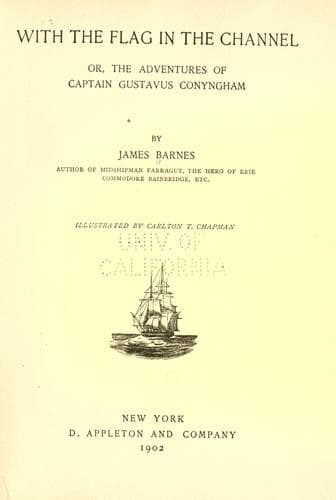
With the Flag in the Channel; or, The Adventures of Captain Gustavus ConynghamBarnes, James
History
With the Flag in the Channel; or, The Adventures of Captain Gustavus Conyngham
Barnes, James
United States -- History -- Revolution, 1775-1783 -- Juvenile fiction
“You certainly can do so, sir,” was the quiet reply, “and need not fear
that I will disturb you; but as you seem to have lost your appetites,
I shall first ask that you all come on deck.” With a polite bow he
ushered the party to the companionway.
Perhaps he had divined the young Englishman’s purpose. At all events,
the suspicion had crossed his mind that the latter only wished
to obtain time to secrete or destroy some of the papers in the
dispatch-box that showed beneath a locker on one side of the cabin.
With some show of discontent, the party followed his suggestions,
however, and went up on deck. Once there they could not conceal their
surprise at the state of affairs. There was the strange vessel, that
was but slightly larger than their own, still made fast to them, and
rippling almost overhead was the big rattlesnake flag. Perhaps, despite
Conyngham’s assurance, they had expected to see the Jolly Roger with
the skull and cross-bones, and they were to all appearances relieved.
The English crew were all under hatches forward, and no one was in
sight but five or six of the Surprise’s crew, who, to tell the truth,
were piratical enough in appearance to belie even the striped flag.
Leaving a guard over his guests, Conyngham went below with the first
mate and began a search of the cabin. When he came on deck again he
plainly perceived the importance of his prize. But a complication had
arisen that made him form his plans quickly. It would never do to delay
the mails or interfere with the diplomatic correspondence intended
for a friendly power, and there were letters for Prussia and Holland,
besides those addressed to the British ambassador at Paris. The private
property of the merchants was unmolested, but a report showed that the
contents of the hold was of no little value, and under the usages of
war it would be fair booty. So Conyngham ordered that Captain Baxter
should accompany him on board the Surprise, and with ill grace the
latter did so. After giving orders to the first mate, whom he left in
command of the Prince of Orange, Conyngham ordered the two vessels to
be cast loose from each other, and the course was laid southeast by
east for Dunkirk once again. He realized that there would be a great
row made upon his landing, but in view of the connivance of the French
Government at the sale of the prizes brought in by Captain Wickes,
that were allowed to be disposed of just outside the harbor limits of
Nantes, he thought that with the aid of Franklin’s growing importance
at the French court the Government would be more than lenient with him.
He supposed at least they would allow him an opportunity to dispose of
the vessel and its contents for what the commissioners in Paris most
needed, namely, gold; and, thinking that he would place himself in a
good position to ask any favors by his conduct in connection with
the foreign mails, he held no anxiety concerning himself or his crew.
Public-domain text, read in full here on John Shaqi.
Reviews
Reviews
No reviews yet
Be the first to share your thoughts on this work.
Join the Discussion
Join the discussion
Sign in to leave a comment or review.
Sign InorCreate an account