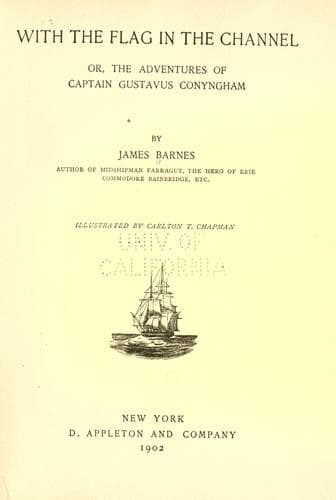
With the Flag in the Channel; or, The Adventures of Captain Gustavus ConynghamBarnes, James
History
With the Flag in the Channel; or, The Adventures of Captain Gustavus Conyngham
Barnes, James
United States -- History -- Revolution, 1775-1783 -- Juvenile fiction
Once, forced by a hard blow, Conyngham had boldly made into the
mouth of the English harbor of Ravenglass, in Lancashire, where of
course he dared not go ashore, and owing to the presence of a British
thirty-four-gun frigate he could not cut out any of the numerous fleet
of merchant vessels by which he was surrounded. When the storm was over
he sailed out of the harbor as boldly as he had entered it, and none
of the English fleet imagined that the natty little craft that dropped
anchor among them was the dreaded Yankee “pirate.”
But now to the adventure: The supply of water was growing less and
less. It became an absolute necessity to fill the casks in some
fashion, and also to procure some fresh provisions, for scurvy, the
dreaded enemy of sailors of that day, had begun to appear--at least
there were signs of it, and the crew were grumbling louder than ever.
So Conyngham bethought him of his promise to pay a visit to the land
of his birth; and after skirting the Isle of Man in a fruitless search
for a safe landing-place or a well-provisioned prize, he crossed the
Channel and entered the harbor of a little Irish fishing port (the
name of which he fails to record in his log) about twenty miles or
so to the north of the town and harbor of Wicklow.
[Illustration: The dreaded Revenge was lying in the harbor.]
Probably the fisher folk were simple and unsuspicious; mayhap they
did not care to inquire closely into the mission of a polite fellow
countryman who claimed to be a peaceable merchantman, for here
Conyngham allowed his original nationality to be unmistakably plain if
he did conceal his calling; or maybe it was the sight of the Spanish
gold with which he paid for everything that blinded them; but they were
eager and willing to help him to the things he wanted; and as many
hands make light work, twelve hours sufficed to fill his casks with
fresh water and his forehold with potatoes--the best cure for scurvy.
Stores of various kinds to replace those he had sent to Spain were also
taken on board.
It was a misty, foggy day, with very little wind. The red evening sun
could not pierce the thick clouds, and the falling barometer proved
that heavy weather might be expected. Conyngham was anxious to be off.
He did not relish being kept longer in port than was necessary; for,
although he had seen that no vessel, even of small size, had sailed
out the harbor, he could not tell but that some suspicious person had
traveled overland to Wicklow bearing the news that the dreaded Revenge
was lying in the harbor. So, just before darkness set in, he bade
good-by to his friendly countrymen, and getting up his anchor drifted
out with the tide toward the Channel.
There was a steep headland to the south, and just as the Revenge was
rounding it a vessel came into full view that, from her appearance,
could be none other than a British cutter. There was hardly enough wind
to fill her sails, and like the Revenge she was drifting slowly with
the tide.
Public-domain text, read in full here on John Shaqi.
Reviews
Reviews
No reviews yet
Be the first to share your thoughts on this work.
Elsewhere in the archive
Join the Discussion
Join the discussion
Sign in to leave a comment or review.
Sign InorCreate an account