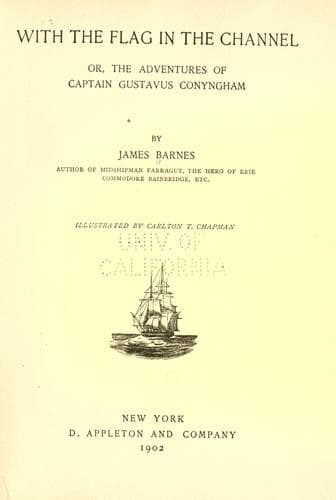
With the Flag in the Channel; or, The Adventures of Captain Gustavus ConynghamBarnes, James
History
With the Flag in the Channel; or, The Adventures of Captain Gustavus Conyngham
Barnes, James
United States -- History -- Revolution, 1775-1783 -- Juvenile fiction
It would be hard to conjecture what it was that caused her captain
to be suspicious, but immediately upon sighting Conyngham’s vessel
two boats were lowered from the cutter’s side and filled with armed
men. They pulled out as if to intercept him. There were altogether
in the Revenge’s crew at this time but some thirty men left, but at
once the long twelve was cast loose and the short broadside guns were
double-shotted. Before the boats had traversed half the distance they
were stopped by a challenging shot from the twelve-pounder, and with
all haste they made back to their vessel. Although she was evidently of
heavier metal, had Conyngham had his full complement of men he would
not have shrunk from engaging her, but under the circumstances, as he
had once remarked before, “discretion was the better part of valor,”
and at long range a drifting fight began.
If the people of the little fishing port had been at all in doubt as
to who their visitor was, all such uncertainty was put at rest by
the appearance the next morning of the cutter with her jib-boom and
topsail-yard shot away and three shot holes in her hull, one at the
water-line that necessitated immediate attending to.
The Revenge had escaped all injury except to her larder, a chance shot
having entered at her cabin window and completely spoiled the captain’s
dinner; thence glancing into the galley, it broached a barrel of fine
salt pork, and ended by lodging in one of the deck beams.
The cruise had ended in an adventure at last, although a rather tame
one, and, satisfied with results, Captain Conyngham determined to set
sail for America.
Another prize was added to his list before he was quite free of the
Channel, and this was ordered to meet him at a port in the Spanish West
Indies, toward which he now laid his course, as he deemed it much wiser
to ascertain how matters stood in America before making for any home
port, which, for all he knew, might be in possession of the enemy.
He was satisfied with the work that he had accomplished, and well he
might be. Perhaps the result of his cruises had been exaggerated, but
he had prevented the sailing of two loaded transports, and from the
very fear of his name over forty sail of vessels of all kinds, to quote
from a contemporaneous account, “lay at anchor cooped up in the Thames.”
As Silas Deane wrote to Robert Morris and to the home Government,
“His name has become more dreaded than that of the great Thurot, and
merchants are constrained to ship their cargoes in French or Dutch
vessels.”
Public-domain text, read in full here on John Shaqi.
Reviews
Reviews
No reviews yet
Be the first to share your thoughts on this work.
Elsewhere in the archive
Join the Discussion
Join the discussion
Sign in to leave a comment or review.
Sign InorCreate an account