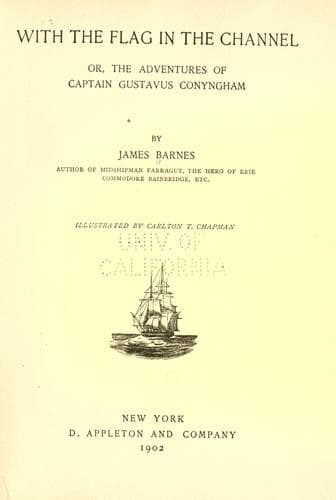
With the Flag in the Channel; or, The Adventures of Captain Gustavus ConynghamBarnes, James
History
With the Flag in the Channel; or, The Adventures of Captain Gustavus Conyngham
Barnes, James
United States -- History -- Revolution, 1775-1783 -- Juvenile fiction
Not a guard-ship on the coast but had received specific orders to be on
the lookout for him, and yet he had cruised in the English and Irish
Channels for month after month. Another fact that he regarded with
satisfaction was that he had accomplished all this not merely as a
privateersman, but as a regularly commissioned officer in the navy of
his country. The prize-money due him as such, now amounting to a large
sum, he regarded as safe in the hands of the commissioners.
After reaching the West Indies, where he spent some time, he learned
from the American consul of the condition of affairs at home, and
after waiting for the arrival of the latest prize he set sail for
Philadelphia. The one thing that he regretted was the fact that he
did not have in his possession the commission signed by John Hancock,
then president of Congress, and given to him by Franklin in Paris, but
he did not doubt that the good doctor had it in his possession and
would produce it at the proper time. Without mishap, the Revenge sailed
up the coast, slipped by the British guard-ships off the capes of
Delaware, and early in February, 1779, Conyngham was home at last!
CHAPTER XV
THE CAPTURE
Of all the surprised people in Philadelphia, James Nesbit was the most
astonished when into his office walked the young seaman who almost
four years before had left in command of the Charming Peggy. The fame
of his doings of course had reached America, and Mr. Nesbit’s brother
had written at some length of Conyngham’s career in the Surprise, his
subsequent arrest, and mysterious release; but it was not until he had
spent a long afternoon in the coffee-room of the little inn around the
corner, and had listened to the captain’s modest and half-humorous
account of his doings, that he understood what had happened in France;
and he followed with breathless interest the career of the two little
vessels that had flown the flag in the Channel.
When Conyngham had finished at last, Mr. Nesbit, who had not allowed
himself to interrupt the recital by even so much as a question,
propounded his first interrogation.
“And what do you intend to do now, Brother Conyngham?” he said. “Of
course you do not mean to rest idle upon either your oars or your
laurels.”
“I suppose I shall have to wait orders from the Naval Committee,” was
the reply. “As an officer in the regular service, I have already
reported my arrival and asked for an audience on the morrow. I hope,”
he added, “they will see fit to make use of my services.”
“There is little hope of finding them in a mood to adopt any
proposition of an aggressive nature,” returned Mr. Nesbit ponderously,
“and there are few commands lying idle. It is as much as Congress can
do to keep our army supplied with clothing, food, and ammunition. The
fleet under Admiral Hopkins did not meet with any signal success.
England is too strong for us on the sea.”
Public-domain text, read in full here on John Shaqi.
Reviews
Reviews
No reviews yet
Be the first to share your thoughts on this work.
Elsewhere in the archive
Join the Discussion
Join the discussion
Sign in to leave a comment or review.
Sign InorCreate an account