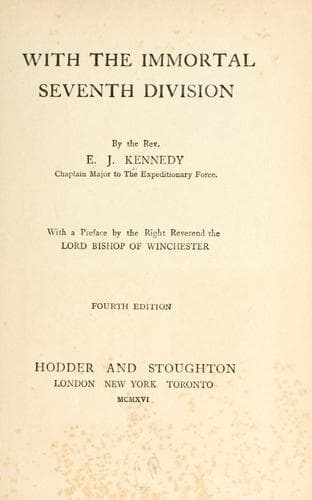
With The Immortal Seventh DivisionKennedy, Edmund John
History
With The Immortal Seventh Division
Kennedy, Edmund John
World War, 1914-1918 -- Personal narratives, British
The position of the two Divisions from this point onwards was one
of grave danger. They were forced by the overwhelming superiority
in numbers of the enemy to retire. From Ghent all the way to
Ypres it was a desperate rearguard fight. They had to trek across
a difficult country without any lines of communication and
without a base, holding on doggedly from position to position,
notably at Thielt and Roulers, until they took up their final
stand before Ypres. What that stand has meant to England will one
day be recognized. What it cost these troops, and how they
fought, will be recorded in the proudest annals of their
regiments.
After the deprivations and the tension of being pursued through
day and night by an infinitely stronger force, these two
Divisions had yet to pass through the worst ordeal of all. It was
left to a little force of 30,000 to keep the German Army at bay
for some days while the other British Corps were being brought
up from the Aisne (the First Corps did not come to their
assistance till October 21). Here they hung on like grim death,
with almost every man in the trenches holding a line which was of
necessity a great deal too long--a thin, exhausted line against
which the prime of the German first line troops were hurling
themselves with fury. The odds against them were about eight to
one, and when once the enemy found the range of a trench, the
shells dropped into it from one end to the other with the most
terrible effect. Yet the men stood firm and defended Ypres in
such a manner that a German officer afterwards described their
action as a brilliant feat of arms, and said that they were under
the impression that there had been four British Corps against
them at this point.
When the two Divisions were afterwards withdrawn from the firing
line to refit, it was found that in the Infantry alone, out of
the 400 officers who set out from England, there were only
forty-four left, and out of 12,000 men only 2,336. So far, little
has been published about the work of these Divisions--probably
because the bulk of the various dispatches is so great. It may be
well, therefore, to place on record now an achievement which will
one day be reckoned, no doubt, among the finest of the kind in
British military history.'
Public-domain text, read in full here on John Shaqi.
Reviews
Reviews
No reviews yet
Be the first to share your thoughts on this work.
Join the Discussion
Join the discussion
Sign in to leave a comment or review.
Sign InorCreate an account