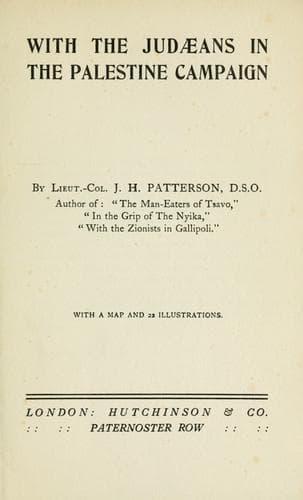
With the Judæans in the Palestine Campaign — John Shaqi
With the Judæans in the Palestine CampaignPatterson, J. H. (John Henry)
History
With the Judæans in the Palestine Campaign
Patterson, J. H. (John Henry)
World War, 1914-1918 -- Campaigns -- Palestine; World War, 1914-1918 -- Participation, Jewish
I visited him in hospital, as did also our Chaplain and others, and we
cheered him up as much as possible, but he died on the 20th, and his
death cast a gloom over the whole battalion, for he was a most
conscientious officer, a good Jew, and well liked by all ranks. He was
buried with full Jewish rites, a "Minyan" from the battalion attending.
The Commander-in-Chief in General Orders eulogised the gallant attempt
which he made when he sacrificed his own life in his plucky effort to
save others.
On the 24th July I was requested by Dr. Weizmann to bring a
representative party of officers and men of the battalion to a most
interesting ceremony at Jerusalem--the laying of the foundation stones
of the Hebrew University On Mount Scopus.
In the days of her past greatness the law was expounded at Jerusalem. It
is quite possible that again, even in our own days, we shall hear a
message of peace and goodwill issue forth from the Temple of Learning
overlooking the Holy City.
The site chosen for the building is a magnificent one. It looks down on
the domes and minarets of Jerusalem on the one side, and, on the other,
overlooks the Jordan Valley and the Dead Sea, with the green hills of
Moab looming in the distance.
The ceremony itself was a most interesting one. The Commander-in-Chief
was present; also all the civil and religious heads of the Jewish,
Christian, and Moslem communities, while a vast multitude of people of
all creeds thronged along the slopes of Scopus from Jerusalem--a
seemingly good omen for future peace and concord. It was a truly
inspiring and historic occasion, and augured well for the future
greatness of the University. Stones were laid by the Christian Bishop
in Jerusalem and by the Mufti (the Chief Mohammedan dignitary). One was
also laid by Dr. Weizmann in the name of the Jewish Regiment, while what
perhaps appealed to me most of all was the part taken by Jewish children
in laying a stone representing the Hope of Israel.
On my return to the Battalion I found the Headquarters encamped in a
pretty grove of olives on the Inniskilling Road, some two miles behind
the firing line. While we were here our Chaplain, the Rev. L. A. Falk,
one day discovered a red granite column embedded in the side of a hill.
This we unearthed and, on measuring it, found that it was about 12 feet
high and about 2 feet in diameter. We erected it in our camp in a grove
of olive trees. I much perturbed our good Rabbi by chaffingly suggesting
to him that we had been erecting an altar to Baal, in a grove, in one of
the high places! Our find got noised abroad, and the Governor of
Jerusalem, Colonel Storrs, with his assistant, Lord William Percy,
motored out from Jerusalem to see it. They had lunch with us, and I was
delighted to note that Lord William Percy took a keen interest in
preserving the fauna of Palestine, and had induced General Allenby to
impose strict limitations on the shooting of birds and beasts.
Public-domain text, read in full here on John Shaqi.
Reviews
Reviews
No reviews yet
Be the first to share your thoughts on this work.
Join the Discussion
Join the discussion
Sign in to leave a comment or review.
Sign InorCreate an account