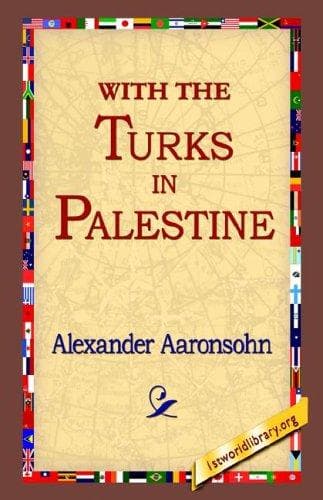
Palestine; World War, 1914-1918 -- Personal narratives
As I proceeded on my journey northward, I hoped to find consolation and
brighter prospects in the independent province of the Lebanon. Few
Americans know just what the Lebanon is. From the repeated allusions in
the Bible most people imagine it to be nothing but a mountain. The truth
is that a beautiful province of about four thousand square miles bears
that name. The population of the Lebanon consists of a Christian sect
called Maronites and the Druses, the latter a people with a secret
religion the esoteric teachings of which are known only to the
initiated, and never divulged to outsiders. Both these peoples are
sturdy, handsome folk. Through the machinations of the Turks, whose
policy is always to "divide and rule," the Maronites were continually
fighting against the Druses. In 1860 Turkish troops joined with the
Druses and fell upon the Maronites with wholesale massacres that spread
as far south as Damascus, where ten thousand Christians were killed in
two days.
[ILLUSTRATION: THE CHRISTIAN TOWN OF ZAHLEH IN THE LEBANON]
The European powers were moved at last. Fifty warships were sent to
Beirut, and ten thousand French troops were landed in the Lebanon, to
create order. Under the pressure of the European powers the Sublime
Porte was forced to grant an autonomy for the province of the Lebanon.
The French, English, German, Russian, Austrian, and, a year later, the
Italian, Governments were signing the guaranty of this autonomy.
Since then the Lebanon has had peace. The Governor of the province must
always be a Christian, but the General Council of the Lebanon includes
representatives of all the different races and religions of the
population. A wonderful development began with the liberation from
Turkish oppression. Macadamized roads were built all over the province,
agriculture was improved, and there was complete safety for life and
property. There is a proverb now in Palestine and Syria which says, "In
the Lebanon a virgin may travel alone at midnight and be safe, and a
purse of gold dropped in the road at midday will never be stolen." And
the proverb told the literal truth.
When one crossed the boundary from Turkish Palestine into the Lebanon
province, what a change met his eyes!--peaceful and prosperous villages,
schools filled with children, immense plantations of mulberry trees and
olives, the slopes of the mountains terraced with beautiful vineyards, a
handsome and sturdy population, police on every road to help the
stranger, and young girls and women with happy laugh and chatter working
in the fields. With a population of about six hundred thousand this
province exported annually two million dollars' worth of raw silk,
silkworm-raising being a specialty of the Lebanon.
Public-domain text, read in full here on John Shaqi.
Reviews
Reviews
No reviews yet
Be the first to share your thoughts on this work.
Join the Discussion
Join the discussion
Sign in to leave a comment or review.
Sign InorCreate an account