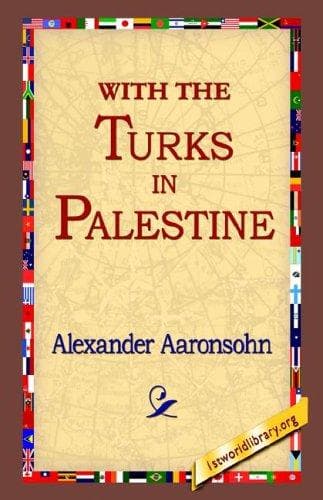
Palestine; World War, 1914-1918 -- Personal narratives
More important than all these, a communistic village government was
established, in which both sexes enjoyed equal rights, including that of
suffrage--strange as this may seem to persons who (when they think of
the matter at all) form vague conceptions of all the women-folk of
Palestine as shut up in harems.
A short experience with Turkish courts and Turkish justice taught our
people that they would have to establish a legal system of their own;
two collaborating judges were therefore appointed--one to interpret the
Mosaic law, another to temper it with modern jurisprudence. All Jewish
disputes were settled by this court. Its effectiveness may be judged by
the fact that the Arabs, weary of Turkish venality,--as open and
shameless as anywhere in the world,--began in increasing numbers to
bring their difficulties to our tribunal. Jews are law-abiding people,
and life in those Palestine colonies tended to bring out the fraternal
qualities of our race; but it is interesting to note that in over thirty
years not one Jewish criminal case was reported from forty-five
villages.
Zicron-Jacob was a little town of one hundred and thirty "fires"--so we
call it--when, in 1910, on the advice of my elder brother, who was head
of the Jewish Experiment Station at Athlit, an ancient town of the
Crusaders, I left for America to enter the service of the United States
in the Department of Agriculture. A few days after reaching this country
I took out my first naturalization papers and proceeded to Washington,
where I became part of that great government service whose beneficent
activity is too little known by Americans. Here I remained until June,
1913, when I returned to Palestine with the object of taking
motion-pictures and stereopticon views. These I intended to use in a
lecturing tour for spreading the Zionist propaganda in the United
States.
During the years of my residence in America, I was able to appreciate
and judge in their right value the beauty and inspiration of the life
which my people led in the Holy Land. From a distance, too, I saw better
the need for organization among our communities, and I determined to
build up a fraternal union of the young Jewish men all over the country.
Two months after my return from America, an event occurred which gave
impetus to these projects. The physician of our village, an old man who
had devoted his entire life to serving and healing the people of
Palestine, without distinction of race or religion, was driving home one
evening in his carriage from a neighboring settlement. With him was a
young girl of sixteen. In a deserted place they were set upon by four
armed Arabs, who beat the old man to unconsciousness as he tried, in
vain, to defend the girl from the terrible fate which awaited her.
Public-domain text, read in full here on John Shaqi.
Reviews
Reviews
No reviews yet
Be the first to share your thoughts on this work.
Join the Discussion
Join the discussion
Sign in to leave a comment or review.
Sign InorCreate an account