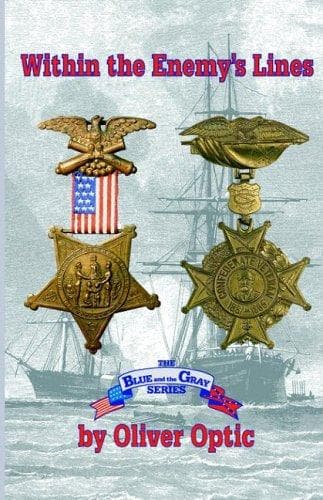
Steamboats -- Juvenile fiction; United States -- History -- Civil War, 1861-1865 -- Naval operations -- Juvenile fiction; War stories
"When I parted with my brother on board of the Bellevite, both of us
shed tears as we realized that war made enemies of us; but each of us
promised to do all he could for the other in case of need. I am very
sure that there was not the slightest unkind feeling between us. Of
course, I did not expect him to write me the war news, but I think he
could have written a few lines without any allusion to the war," said
Captain Passford, pained at this want of filial affection on the part
of his brother.
At that moment the bell for tea rang, and the captain invited his nephew
to the table with him. The host was saddened by the absence of news from
his brother, of any kindly expression from one who was of the same blood
as himself. He was not quite satisfied with Corny's manner, or with the
little he seemed to be willing to say about the rest of the family. It
was certainly very strange that the young man should be there at all,
and his awkwardness and confusion made the visit seem still more
singular.
It was possible that the young man had just arrived and was fatigued
by the trials and perils of his trip, for he must have come by some
roundabout way; and very likely he felt nervous and uneasy in the midst
of people who were loyal to the government and the Union. Captain
Passford decided to say nothing more to his nephew at present as to
the occasion and the manner of his visit to Bonnydale, and during the
evening meal he avoided all allusion to the war, so far as it was
possible to do so. Mrs. Passford and Florry received him very kindly,
but following the example of the head of the family, they spoke only of
domestic affairs, and of the relations of the two families as they had
been before the war.
Between the brothers Homer and Horatio Passford, even from their early
boyhood, a remarkably strong fraternal affection had subsisted. Both of
them were high-toned men, and both of them had always been faithful in
the discharge of every duty to God and man. Each of them had a wife, a
son and a daughter, and two happier families could not have been found
on the face of the earth. They were not only devoted to each other, each
within its own circle, but the two families were as nearly one as it was
possible to be.
Captain Horatio had formerly been a shipmaster, and had accumulated
an immense fortune. Homer was less fortunate in this respect, and his
tastes were somewhat different from those of his brother. He wanted to
be a planter, and with the financial assistance of his brother, he went
into the business of raising cotton near Mobile, in Alabama. But years
before the war, he had paid off every dollar of his indebtedness to
Horatio, and had made a comfortable fortune besides. The two families
had visited each other as much an possible, and the captain, with his
little family, had been almost to the plantation in the Bellevite, the
magnificent steam-yacht of the Northerner.
Public-domain text, read in full here on John Shaqi.
Reviews
Reviews
No reviews yet
Be the first to share your thoughts on this work.
Join the Discussion
Join the discussion
Sign in to leave a comment or review.
Sign InorCreate an account