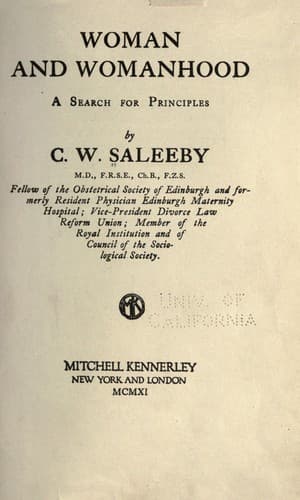
Woman and Womanhood: A Search for PrinciplesSaleeby, C. W. (Caleb Williams)
Science
Woman and Womanhood: A Search for Principles
Saleeby, C. W. (Caleb Williams)
Eugenics; Women
The deeds of men and women proceed from certain radical elements of
their nature, some evidently noble, others, when looked at askew,
apparently ignoble. These elements are classed as instinctive. We are
less intelligent than we think. Reason may occupy the throne, but the
foundations upon which that throne is based are not of her making. To
change the image, reason is the pilot, not the gale or the engine. She
does not determine the goal, but only the course to that goal. We are
what our nature makes us; our likes and our dislikes determine our acts,
and we are guided to our self-determined ends by means of our
intelligence. More often, indeed, we use our intelligence merely to
justify to ourselves the likes and dislikes, the action and the
inaction, which our instinctive tendencies have determined.
Many of our natural instincts, impulses, and emotions bear only remotely
upon our present inquiry; as, for instance, the instinct of flight and
the emotion of fear, the instinct of curiosity and the emotion of
wonder, the instinct of pugnacity and the emotion of anger. Certain
others, however, are not merely radical and permanent parts of our
nature, but determine human existence, the greater part of its failures
and successes, its folly and wisdom, its history and its destiny. Two of
these--the parental and racial instincts--we must carefully consider
here, and also, very briefly, a supposed third, the filial instinct. I
am inclined to question whether such a specific entity as the filial
instinct exists at all; it is rather, I believe, a product, by
transmutation, of the parental instinct which, in its various forms and
potencies and through the tender emotion which is its counterpart in the
affective realm of our natures, is the noblest, finest, and most
promising ingredient of our constitution.
_Instinct and Emotion._--We must be sure, in the first place, that we
have a sound idea of what we mean by the word "instinct." It is absurd,
for instance, to speak of "acquiring a political instinct"--or any
other. That is the most erroneous possible use of the word. An instinct
is eminently something which cannot be "acquired"; it is native if
anything is native; as native as the nose or the backbone. Instincts may
be developed or repressed; it is the great mark of man that in him they
may even be transmuted--but _acquired_ never.
Public-domain text, read in full here on John Shaqi.
Reviews
Reviews
No reviews yet
Be the first to share your thoughts on this work.
Elsewhere in the archive
Join the Discussion
Join the discussion
Sign in to leave a comment or review.
Sign InorCreate an account