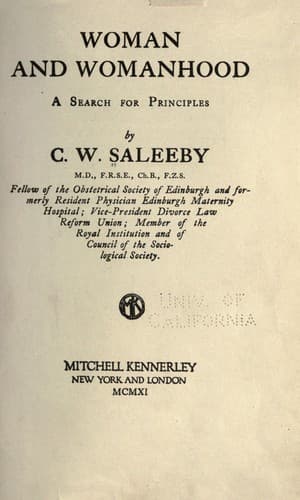
Woman and Womanhood: A Search for PrinciplesSaleeby, C. W. (Caleb Williams)
Science
Woman and Womanhood: A Search for Principles
Saleeby, C. W. (Caleb Williams)
Eugenics; Women
When we come to examine the laws of activity we find that, on the
application of certain kinds of stimulus, there are certain very
definite responses, and these we call instinctive. If the arm or the leg
of a sleeper be stroked or touched, or a cold breath of air blows
thereon, it will be withdrawn, and such withdrawal is what we call a
reflex action. Now, an instinctive action, as Herbert Spencer saw long
ago, is a "complex reflex action." It differs from a simple reflex, a
mere twitch, such as winking, but it is a complicated, and possibly
prolonged, action, which is, at bottom, of the nature of a reflex. One
may instance the instinct of flight, which is correlated with fear. In
crossing the street we hear "toot, toot," and we run. We do not
ratiocinate, we run. All the primary instincts of mankind act similarly.
Take, for contrast, the instinct of curiosity. Consider a child watching
a mechanical toy; the impulse of this instinct of curiosity is such that
he goes to the thing and examines it. By means of the transmutation,
which it is the prerogative of man to effect, this instinct may work out
into a lifetime devoted to the study of Nature. There is an unbroken
sequence from the interest in the unknown which we see in a kitten or a
child up to that which triumphs in a Newton or a Darwin.
Thus we begin to learn that human nature is largely a collection of
instincts, more or less correlated, and that at bottom we act on our
instincts--in accordance with certain innate predilections, likings, and
dislikings with which we were born, and which we have inherited from our
ancestors. Indissolubly associated therewith is what we call emotion.
For instance, in the exercise of the instinct of curiosity we feel a
certain emotion, which we call wonder. There is an ignoble wonder and
there is a noble wonder; but whether it be an astronomer watching the
stars, or the crowd at a cinematograph show, there exists an association
between the emotion of wonder and the instinct of curiosity. Dr.
McDougall, of Oxford, elaborated some few years ago, and has now
established, an extremely important theory of the relation between
instinct and emotion. He has shown that our emotions are correlated with
our instincts; that the emotion is the inward or subjective side of the
working of the instinct. Thus an instinct is more than a "complex reflex
action"; it is more than merely that, on hearing something, or seeing
something, certain muscles are thrown into action, because along with
the action there is emotion, and this is a natural and necessary
correlation. We should do well to carry about with us, as part of our
mental furniture, this idea of the correlation between instinct and
emotion.
Public-domain text, read in full here on John Shaqi.
Reviews
Reviews
No reviews yet
Be the first to share your thoughts on this work.
Elsewhere in the archive
Join the Discussion
Join the discussion
Sign in to leave a comment or review.
Sign InorCreate an account