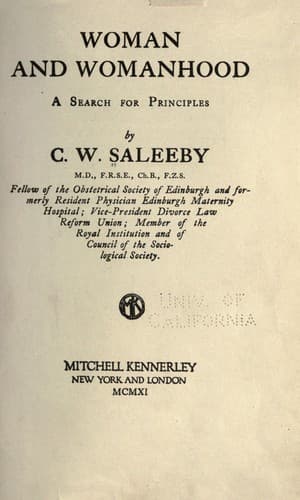
Woman and Womanhood: A Search for PrinciplesSaleeby, C. W. (Caleb Williams)
Science
Woman and Womanhood: A Search for Principles
Saleeby, C. W. (Caleb Williams)
Eugenics; Women
There is also in us an instinct of pugnacity, which especially appears
when the working of any other instinct is thwarted. We know that the
parental instinct when thwarted, as in the tigress robbed of her whelps,
shows itself in pugnacity--even in the female, which commonly has no
pugnacity; and in the emotion of anger. It is a reasonable supposition
that the fine anger, the passion for justice, the passion against, say,
slavery or cruelty to children--that these indignations which move the
world are at bottom traceable to the workings of the outraged parental
instinct. When we have tender emotion towards a child, or towards an
animal, whatever it be, this is really the subjective side of the
working of the parental instinct. Now, tender emotion is what has made
and makes everything that is good in the individual, and in human
society. It is the basis of all morality--all morality that is real
morality--everything that permits us to hold up our heads at all, or to
hope for the future of the race. That is why the study of the parental
instinct, its correlate or source, is as important and serious as any
that can be imagined.
Let us begin by a quotation from Dr. McDougall, author of the best and
most searching account of this instinct yet written:--
"The maternal instinct, which impels the mother to protect and
cherish her young, is common to almost all the higher species of
animals. Among the lower animals the perpetuation of the species is
generally provided for by the production of an immense number of
eggs or young (in some species of fish a single adult produces more
than a million eggs), which are left entirely unprotected, and are
so preyed upon by other creatures that on the average but one or
two attain maturity. As we pass higher up the animal scale, we find
the number of eggs or young more and more reduced, and the
diminution of their number compensated for by parental protection.
At the lowest stage this protection may consist in the provision of
some merely physical shelter, as in the case of those animals that
carry their eggs attached in some way to their bodies. But, except
at this lowest stage, the protection afforded to the young always
involves some instinctive adaptation of the parent's behaviour. We
may see this even among the fishes, some of which deposit their
eggs in rude nests and watch over them, driving away creatures that
might prey upon them. From this stage onwards protection of
offspring becomes increasingly psychical in character, involves
more profound modification of the parent's behaviour, and a more
prolonged period of more effective guardianship. The highest stage
is reached by those species in which each female produces at a
birth but one or two young, and protects them so efficiently that
most of the young born reach maturity; the maintenance of the
Public-domain text, read in full here on John Shaqi.
Reviews
Reviews
No reviews yet
Be the first to share your thoughts on this work.
Elsewhere in the archive
Join the Discussion
Join the discussion
Sign in to leave a comment or review.
Sign InorCreate an account