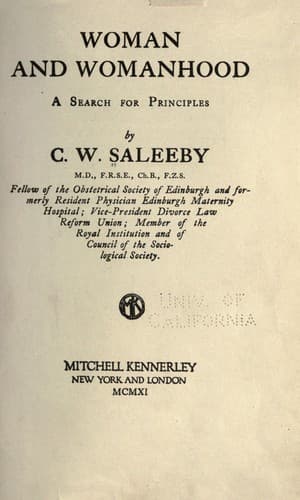
Woman and Womanhood: A Search for PrinciplesSaleeby, C. W. (Caleb Williams)
Science
Woman and Womanhood: A Search for Principles
Saleeby, C. W. (Caleb Williams)
Eugenics; Women
species thus becomes in the main the work of the parental instinct.
In such species the protection and cherishing of the young is the
constant and all-absorbing occupation of the mother, to which she
devotes all her energies, and in the course of which she will at
any time undergo privation, pain, and death. The instinct becomes
more powerful than any other, and can override any other, even fear
itself; for it works directly in the service of the species, while
the other instincts work primarily in the service of the individual
life, for which Nature cares little.... When we follow up the
evolution of this instinct to the highest animal level, we find
among the apes the most remarkable examples of its operation. Thus
in one species the mother is said to carry her young one clasped in
one arm uninterruptedly for several months, never letting go of it
in all her wanderings. This instinct is no less strong in many
human mothers, in whom, of course, it becomes more or less
intellectualized and organized as the most essential constituent of
the sentiment of parental love. Like other species, the human
species is dependent upon this instinct for its continual
existence and welfare. It is true that reason, working in the
service of the egotistic impulses and sentiments, often circumvents
the ends of this instinct and sets up habits which are incompatible
with it. But when that occurs on a large scale in any society, that
society is doomed to rapid decay. But the instinct itself can never
die out save with the disappearance of the human species itself; it
is kept strong and effective just because those families and races
and nations in which it weakens become rapidly supplanted by those
in which it is strong.
"It is impossible to believe that the operation of this, the most
powerful of the instincts, is not accompanied by a strong and
definite emotion; one may see the emotion expressed unmistakably by
almost any mother among the higher animals, especially the birds
and the mammals--by the cat, for example, and by most of the
domestic animals; and it is impossible to doubt that this emotion
has in all cases the peculiar quality of the tender emotion
provoked in the human parent by the spectacle of her helpless
offspring. This primary emotion has been very generally ignored by
the philosophers and psychologists; that is, perhaps, to be
explained by the fact that this instinct and its emotion are in the
main decidedly weaker in men than women, and in some men, perhaps,
altogether lacking. We may even surmise that the philosophers as a
class are men among whom this defect of native endowment is
relatively common."
Public-domain text, read in full here on John Shaqi.
Reviews
Reviews
No reviews yet
Be the first to share your thoughts on this work.
Elsewhere in the archive
Join the Discussion
Join the discussion
Sign in to leave a comment or review.
Sign InorCreate an account