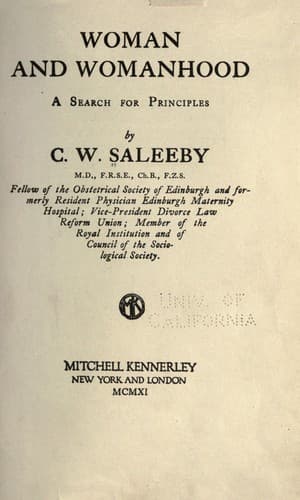
Woman and Womanhood: A Search for PrinciplesSaleeby, C. W. (Caleb Williams)
Science
Woman and Womanhood: A Search for Principles
Saleeby, C. W. (Caleb Williams)
Eugenics; Women
Nothing will be said which militates for a moment against the
possibility that a woman may be womanly and yet in her later years, when
so many women combine their best health and vigour with experience and
wisdom, might replace many hundredweight of male legislators upon the
benches of the House of Commons, to the immense advantage of the nation.
If our present purpose were medical in the ordinary sense, the reader
would come to a chapter on the climacteric, dealing with the nervous and
other risks and disabilities of that period, and notably including a
warning as to the importance of attending promptly to certain local
symptoms which may possibly herald grave disease. An abundance of books
on such subjects is to be had, and my purpose is not to add to their
number. Yet the climacteric has a special interest for us because the
special case of those women who have passed it is constantly ignored in
our discussions of the woman question--which is not exclusively
concerned with the destiny of girls and the claims of feminine
adolescence to the vote. The work of Lord Lister, and the advances of
obstetrics and gynecology, largely dependent thereon, are increasing the
naturally large number of women at these later ages--naturally large
because women live longer than men. At this stage the whole case is
changed. The eugenic criterion no longer applies. But though the woman
is past motherhood, she is still a woman, and by no means past
foster-motherhood. Though her psychological characters are somewhat
modified, it is recorded by my old friend and teacher, Dr. Clouston,
that never yet has he found the climacteric to damage a woman's natural
love for children: the maternal instinct will not be destroyed. See,
then, what a valuable being we have here; none the less so because, as
has been said, she now begins to enjoy, in many cases, the best health
of her life. Whatever activities she adopts, there is now no question of
depriving the race of her qualities: if they are good qualities, it is
to be hoped they are already represented in members of the rising
generation. The scope of womanhood is now extended. The principles to be
laid down later still apply, but they are entirely compatible with, for
instance, the discharge of legislative functions. The nation does not
yet value its old or elderly women aright. We use as a term of contempt
that which should be a term of respect. Savage peoples are wiser. We
need the wisdom of our older women. It would be well for us to have Mrs.
Fawcett and Mrs. Humphry Ward in Parliament. The distinguished lady who
approves of woman's vote in municipal affairs, and fights hard for her
son's candidature in Parliament, but objects to woman suffrage on the
ground that women should not interfere in politics, could doubtless find
a good reason why women should sit in Parliament; and though she would
scarcely be heeded on matters of political theory, her splendid
championship of Vacation Schools and Play Centres would be more
Public-domain text, read in full here on John Shaqi.
Reviews
Reviews
No reviews yet
Be the first to share your thoughts on this work.
Join the Discussion
Join the discussion
Sign in to leave a comment or review.
Sign InorCreate an account