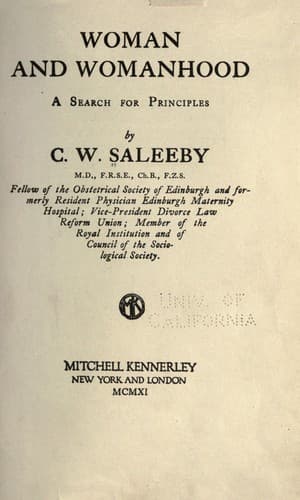
Woman and Womanhood: A Search for PrinciplesSaleeby, C. W. (Caleb Williams)
Science
Woman and Womanhood: A Search for Principles
Saleeby, C. W. (Caleb Williams)
Eugenics; Women
The omission is due to the belief that votes for women or anybody else
are far less important than their advocates or their opponents assume.
The biologist cannot escape the habit of thinking of political matters
in vital terms; and if these lead him to regard such questions as the
vote with an interest which is only secondary and conditional, it is by
no means certain that the verdict of history would not justify him. The
present concentration of feminism in England upon the vote, sometimes
involving the refusal of a good end--such as wise legislation--because
it was not attained by the means they desire, and arousing all manner of
enmity between the sexes, may be an unhappy necessity so long as men
refuse to grant what they will assuredly grant before long. But now, and
then, the vital matters are the nature of womanhood; the extent of our
compliance with Nature's laws in the care of girlhood, whether or not
women share in making the transitory laws of man; and the extent to
which womanhood discharges its great functions of dedicating and
preparing its best for the mothers, and choosing and preparing the best
of men for the fathers, of the future. The vote, or any other thing, is
good or bad in so far as it serves or hurts these great and everlasting
needs. I believe in the vote because I believe it will be eugenic, will
reform the conditions of marriage and divorce in the eugenic sense, and
will serve the cause of what I have elsewhere called "preventive
eugenics," which strives to protect healthy stocks from the "racial
poisons," such as venereal disease, alcohol, and, in a relatively
infinitesimal degree, lead. These are ends good and necessary in
themselves, whether attained by a special dispensation from on high, or
by decree of an earthly autocrat or a democracy of either sex or both.
For these ends we must work, and for all the means whereby to attain
them; but never for the means in despite of the ends.
This first chapter is perhaps unduly long, but it is necessary to state
my eugenic faith, since there is neither room nor need for me to
reiterate the principles of eugenics in later chapters, and since it was
necessary to show that, though this book is written in the interests of
individual womanhood, it is consistent with the principles of the divine
cause of race-culture, to which, for me, all others are subordinate, and
by which, I know, all others will in the last resort be judged.
* * * * *
Public-domain text, read in full here on John Shaqi.
Reviews
Reviews
No reviews yet
Be the first to share your thoughts on this work.
Join the Discussion
Join the discussion
Sign in to leave a comment or review.
Sign InorCreate an account