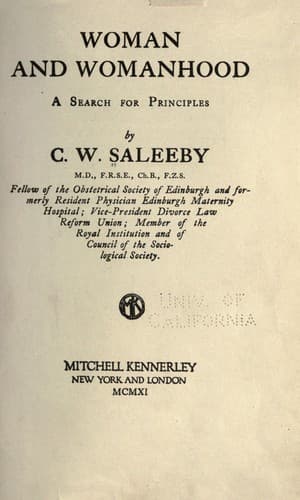
Woman and Womanhood: A Search for PrinciplesSaleeby, C. W. (Caleb Williams)
Science
Woman and Womanhood: A Search for Principles
Saleeby, C. W. (Caleb Williams)
Eugenics; Women
Women, then, are entitled to demand that the conditions of marriage be
so modified as, above all things, to allow them the possession of
themselves as the married man has possession of himself. The imposition
of motherhood upon a married woman in absolute despite of her health and
of the interests of the children is none the less an iniquity because it
has at present the approval of Church and State. It is woman who bears
the great burden of parenthood, and with her the decision must rest. It
is idle to reply that this is impossible, for it is possible, as there
are not a few happy wives throughout the civilized world to bear
testimony. Every new life that comes into being is to be regarded as
sacred from the first. The accident of birth at a particular stage in
its development does not in the slightest degree affect this ethical
principle, as even the law, for a wonder, recognizes. The full
acceptance of the principle that woman must decide is, I am convinced,
the only right and effective way in which to abolish altogether the
dangers at present run by the life which is at once unborn and unwanted.
The decision must be made once and for all _before_ the new life is
called into initial being, and the last word must lie with her who is to
bear it. I am strengthened in the enunciation of this principle by the
reflection that it would be ridiculed and condemned by the vote of every
public-house and music-hall throughout the civilized world.
Let it be observed that in thus allowing the wife the possession of her
own person, we are giving her only what her husband possesses, and that
her possession of herself is of vastly more moment to her than his own
liberty to him. Nothing more than sheer equality is being claimed for
her, and the claim in her case has a double strength, since it is made
valid not only by her own interests but by those of the future. The
future must be protected, and therefore she who is its vessel must be
protected. This is no more than the sub-human mother everywhere has as
her birthright, and however much this teaching may offend the common
male assumption that a wife is a form of property, the future certainly
holds within itself the establishment of this principle.
The question of divorce is so important that we must defer it to the
next chapter.
We have briefly alluded to the question of the wife's possession of
herself. We must now refer to the question, scarcely less important, of
her possession of her own property and her claims upon her husband's. It
is difficult for the present generation to realize that very few decades
have passed since the time when everything which a woman possessed
became, when she married, the property of her husband. That is now a
question which there is no need to discuss, but there remains a very
great issue, lately become prominent, and suggested by the popular
phrase, the endowment of motherhood.
Public-domain text, read in full here on John Shaqi.
Reviews
Reviews
No reviews yet
Be the first to share your thoughts on this work.
Elsewhere in the archive
Join the Discussion
Join the discussion
Sign in to leave a comment or review.
Sign InorCreate an account