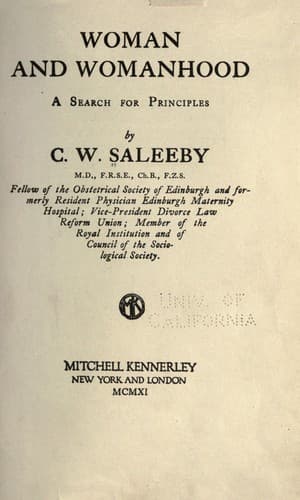
Woman and Womanhood: A Search for PrinciplesSaleeby, C. W. (Caleb Williams)
Science
Woman and Womanhood: A Search for Principles
Saleeby, C. W. (Caleb Williams)
Eugenics; Women
We should obviously be false to our first principles if we did not
assent with all our hearts to the _fundamental_ principle expressed by
this phrase. If it is necessary that the wife be protected as a wife, it
is even more necessary that she be protected as a mother. There are
twelve hundred thousand widows in this country at the present time, and
of these a large number stand in unaided parental relation to a great
multitude of children. I showed some years ago that, as we shall see in
more detail in a later chapter, alcohol makes not less than forty-five
thousand widows and orphans every year in England and Wales. Nothing
can be more certain than that, in the interests of all except the
worthless type of man, the economic protection of motherhood is an
urgent need, less open to criticism perhaps than any other economic
reconstruction proposed by the reformer. Some will argue, of course,
that the State is to look after children directly, but I, for one, as a
biologist, have no choice but to believe that the way to save children
is to safeguard parenthood, and I cannot question that our duty is to
provide the mother with the necessary means for performing her supreme
function, whether she has a living husband or is a widow or is
unmarried.
The question remains, how is this to be done, and whence is the money to
be obtained?
Here we join issue with those Socialist writers who advocate the
endowment of motherhood and give it their own meaning; and that is why
in a preceding paragraph the word fundamental has been emphasized, since
in the endowment of motherhood as understood by socialists there are two
principles, one which I call fundamental, and a second--that the
endowment shall be by the State--which now falls to be considered. I do
not see how any one can challenge the following sentences from Mr. H. G.
Wells:
"So the monstrous injustice of the present time which makes a
mother dependent upon the economic accidents of her man, which
plunges the best of wives and the most admirable of children into
abject poverty if he happens to die, which visits his sins of waste
and carelessness upon them far more than upon himself, will
disappear. So too the still more monstrous absurdity of women
discharging their supreme social function, bearing and rearing
children in their spare time, as it were, while they earn their
living by contributing some half mechanical element to some trivial
industrial product, will disappear."[18]
Public-domain text, read in full here on John Shaqi.
Reviews
Reviews
No reviews yet
Be the first to share your thoughts on this work.
Elsewhere in the archive
Join the Discussion
Join the discussion
Sign in to leave a comment or review.
Sign InorCreate an account