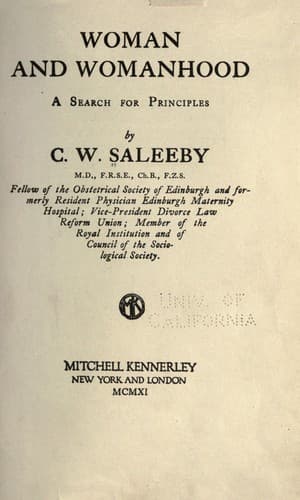
Woman and Womanhood: A Search for PrinciplesSaleeby, C. W. (Caleb Williams)
Science
Woman and Womanhood: A Search for Principles
Saleeby, C. W. (Caleb Williams)
Eugenics; Women
We are often and rightly reminded that woman is half the human race. It
is truer even than it appears. Not only is woman half of the present
generation, but present woman is half of all the generations of men and
women to come. The argument of this book, which will be regarded as
reactionary by many women called "advanced"--presumably as doctors say
that a case of consumption is "advanced"--involves nothing other than
adequate recognition of the importance of woman in the most important of
all matters. It is true that my primary concern has been to furnish, for
the individual woman and for those in charge of girlhood, a guide of
life based upon the known physiology of sex. But it is a poor guide of
life which considers only the transient individual, and poorest of all
in this very case.
If it were true that woman is merely the vessel and custodian of the
future lives of men and women, entrusted to her ante-natal care by their
fathers, as many creeds have supposed, then indeed it would be a
question of relatively small moment how the mothers of the future were
chosen. Our ingenious devices for ensuring the supremacy of man lend
colour to this idea. We name children after their fathers, and the fact
that they are also to some extent of the maternal stock is obscured.
But when we ask to what extent they are also of maternal stock, we find
that there is a rigorous equality between the sexes in this matter. It
is a fact which has been ignored or inadequately recognized by every
feminist and by every eugenist from Plato until the present time.
Salient qualities, whether good or ill, are more commonly displayed by
men than by women. Great strength or physical courage or endurance,
great ability or genius, together with a variety of abnormalities, are
much more commonly found in men than in women, and the eugenic emphasis
has therefore always been laid upon the choice of fathers rather than of
mothers. Not so long ago, the scion of a noble race must marry, not at
all necessarily the daughter of another noble race, but rather any young
healthy woman who promised to be able to bear children easily and suckle
them long. But directly we observe, under the microscope, the facts of
development, we discover that each parent contributes an exactly equal
share to the making of the new individual, and all the ancient and
modern ideas of the superior value of well-selected fatherhood fall to
the ground. Woman is indeed half the race. In virtue of expectant
motherhood and her ante-natal nurture of us all, she might well claim
to be more, but she is half at least.
And thus it matters for the future at least as much how the mothers are
chosen as how the fathers are. This remains true, notwithstanding that
the differences between men, commending them for selection or rejection,
seem so much more conspicuous and important than in the case of women.
Public-domain text, read in full here on John Shaqi.
Reviews
Reviews
No reviews yet
Be the first to share your thoughts on this work.
Join the Discussion
Join the discussion
Sign in to leave a comment or review.
Sign InorCreate an account