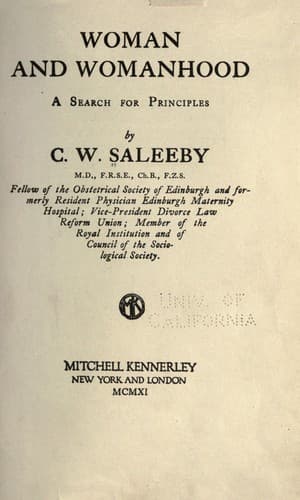
Woman and Womanhood: A Search for PrinciplesSaleeby, C. W. (Caleb Williams)
Science
Woman and Womanhood: A Search for Principles
Saleeby, C. W. (Caleb Williams)
Eugenics; Women
"The claim of motherhood as a factor in economic exchange is false
to-day. But suppose it were true. Are we willing to hold this
ground, even in theory? Are we willing to consider motherhood as a
business, a form of commercial exchange? Are the cares and duties
of the mother, her travail and her love, commodities to be
exchanged for bread?
"It is revolting so to consider them; and if we dare face our own
thoughts, and force them to their logical conclusion, we shall see
that nothing could be more repugnant to human feeling, or more
socially and individually injurious, than to make motherhood a
trade."
Surely this is special pleading and not very plausible at that. It may
be replied, "Is not the labourer worthy of his hire?"--however noble the
labour. If we choose to call society's or a husband's support of
motherhood "a form of commercial exchange," it is indeed "revolting" so
to see it; let us then look at the case as it is. We applaud the "cares
and duties of the mother, her travail and her love"; but the more
assiduous her maternity, and the more admirable, the more certainly will
she require to be fed. If she cannot simultaneously feed her child and
forage for herself, somebody must forage for her; and to say that
therefore the cares and duties of the mother, her travail and her love,
become commodities to be exchanged for bread, is simply to cloud a clear
case with question-begging epithets. Always, everywhere, if motherhood
is to be performed at its highest, the mother must be supported. It is
not a question of commercial exchange, but of obvious natural necessity.
The foregoing chapter with its argument for the rights of mothers as a
great and neglected social principle, may be unsound throughout, but it
will certainly not be refuted by sentences such as these.
Briefly, Mrs. Gilman proposes to "do away with the family kitchen and
dining-room, to transform all domestic service from the incapable,
hand-to-mouth standard of untrained amateurs to that of professional
experts, to raise the work of child nursing and rearing to a scientific
and skilled basis, to secure the self-support of the wife and mother
through skilled labour, so that she may be economically independent of
her husband."
But if her child nursing and rearing are to be scientific and skilled,
and she is simultaneously to support herself through skilled labour, she
clearly requires to be two women or one woman in two places at the same
time. This, in effect, is what Mrs. Gilman expects. We have seen that
Mr. H. G. Wells's proposed help for motherhood consists in discharging
fatherhood from its duties: Mrs. Gilman's idea is to double the mother's
work. Both come to much the same thing.
Public-domain text, read in full here on John Shaqi.
Reviews
Reviews
No reviews yet
Be the first to share your thoughts on this work.
Elsewhere in the archive
Join the Discussion
Join the discussion
Sign in to leave a comment or review.
Sign InorCreate an account