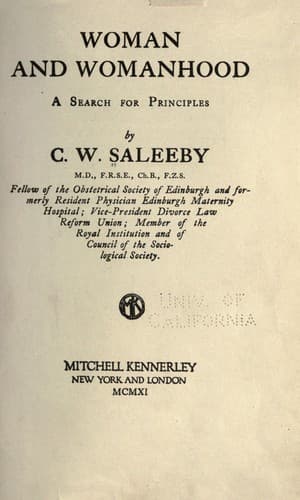
Woman and Womanhood: A Search for PrinciplesSaleeby, C. W. (Caleb Williams)
Science
Woman and Womanhood: A Search for Principles
Saleeby, C. W. (Caleb Williams)
Eugenics; Women
All women, mothers or other, are to become economically independent,
instead of being "parasitic on the male," our author's unpleasing way of
recognizing that fatherhood has reached high and responsible estate
amongst mankind. Now if Mrs. Gilman's solution be feasible, we must
return to our fundamentals and see whether they are compatible with it.
She has no doubt of it. Thus:--
"If it could be shown that the women of to-day were growing beards,
were changing as to pelvic bones, were developing bass voices, or
that in their new activities they were manifesting the destructive
energy, the brutal combative instinct, or the intense sex-vanity of
the male, then there would be cause for alarm. But the one thing
that has been shown in what study we have been able to make of
women in industry is that they are women still, and this seems to
be a surprise to many worthy souls ... 'the new woman' will be no
less female than the 'old' woman ... she will be, with it all, more
feminine.
"The more freely the human mother mingles in the natural industries
of a human creature, as in the case of the savage woman, the
peasant woman, the working-woman everywhere who is not overworked,
the more rightly she fulfils these functions."[20]
We may not be so sure that there is not some evidence for "growing
beards," "developing bass voices," and "manifesting the destructive
energy, the brutal combative instinct, or the intense sex-vanity of the
male"; and in our brief attempt to make a first study of womanhood in
the light of Mendelism, we have seen good reason to understand why
masculine characters may come to the surface in the female whose
femininity has worn thin. Several of the lower animals definitely show
us the possibilities.
But we need not accept the issue on the grounds of such superficial
manifestations as these, for there are others, more subtle and vastly
more important, on which must be fought the question whether women in
industry are women still, and whether the "new woman" is more feminine
than the old. Let us dismiss the extremes in both directions. We need
not adduce the members of the Pioneer Club, who show their increasing
femininity by donning male attire; nor need we question that large
numbers of women in industry continue to remain feminine still. The
practical question which we must determine, if possible, is the average
effect of industrial conditions and the assumption of the functions
commonly supposed to be more suitably masculine, upon women in general.
Here we definitely join issue with Mrs. Gilman.
Public-domain text, read in full here on John Shaqi.
Reviews
Reviews
No reviews yet
Be the first to share your thoughts on this work.
Elsewhere in the archive
Join the Discussion
Join the discussion
Sign in to leave a comment or review.
Sign InorCreate an account