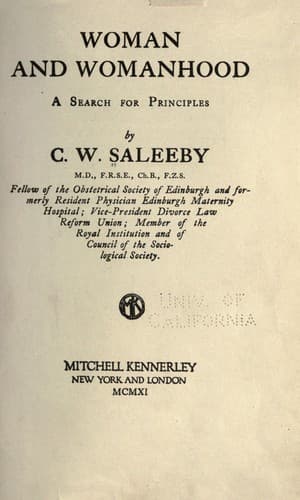
Woman and Womanhood: A Search for PrinciplesSaleeby, C. W. (Caleb Williams)
Science
Woman and Womanhood: A Search for Principles
Saleeby, C. W. (Caleb Williams)
Eugenics; Women
But whilst popular preachers and castigators of the sins of society
fulminate against the fine lady who asks for belladonna and refuses to
do her duty, we must enquire to what extent, if any, women no longer
nurse their babies because they cannot, try they never so patiently and
strenuously. It is the general belief amongst those whose daily work
qualifies them for an opinion, that women are tending to lose the power
of nursing. Professor von Bunge, whose name is honoured by all students
of the action of drugs, has satisfied himself that alcoholism in the
father is a great cause of incapacity to nurse in daughters. However
that interpretation may be, the fact seems clear; and the change in this
direction is evidently much more rapid than might be accounted for by
the improvement in artificial feeding of infants leading to the survival
of daughters of mothers unable to nurse, and transmitting their
inability to their children. Mrs. Gilman--having ignored menstruation
altogether--makes only one allusion to this vastly important subject,
and we shall see to what extent her sanguine assumption is justified.
According to her, "A healthy, happy, rightly occupied motherhood should
be able to keep up this function (of nursing) longer than is now
customary--to the child's great gain." There can be no question about
the child's great gain; but what is the evidence for supposing that a
mother earning her own living in free competition with men--which is
what a "healthy, happy, rightly occupied motherhood" means in this
connection--can thus spend her energies twice over, unlike any other
source of energy known?
According to official statistics, maternal lactation is steadily
decreasing in several German cities, notably in Berlin, where only 56.2
per cent. of infants under one month were suckled by their mothers in
1905, as against 65.6 per cent. in 1895, and 74.3 per cent. in 1885. At
nine months of age 22.4 per cent. were suckled in 1905, 34.6 per cent.
in 1895, 49 per cent. in 1885. Other towns show more favourable results;
a general decrease, however, is marked. These facts cannot be ascribed,
according to the author,[21] to a growing disinclination to
breast-feeding, nor to the employment of mothers (in Prussia only 5 per
cent. of the married women are employed in manufacture). The question
whether the decrease in breast-feeding is due to the industrial
employment of women before marriage, or to (inherited) degeneration,
remains to be determined.
According to a recent statement by Professor von Bunge, the conditions
are very similar now in Switzerland, where only about one mother in five
can nurse her children.
Similar evidence could be cited from other sources, and the fact being
admitted must evidently be reckoned with.
Public-domain text, read in full here on John Shaqi.
Reviews
Reviews
No reviews yet
Be the first to share your thoughts on this work.
Elsewhere in the archive
Join the Discussion
Join the discussion
Sign in to leave a comment or review.
Sign InorCreate an account