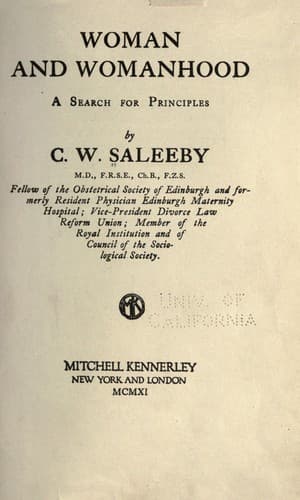
Woman and Womanhood: A Search for PrinciplesSaleeby, C. W. (Caleb Williams)
Science
Woman and Womanhood: A Search for Principles
Saleeby, C. W. (Caleb Williams)
Eugenics; Women
Let us return now to the question of nursing capacity. "Bass voices"
and "beards" are doubtless unlovely in woman, but their extensive
appearance would be of no consequence at all compared with the
disappearance or weakening of the mammalian function which, as everyone
knows or should know, is the dominating factor in the survival or death
of infancy. Now it may be briefly asserted that civilized woman, and
more especially industrial woman, threatens to cease to be a mammal. If
this assertion can be substantiated, and if the "economic independence
of women" necessarily involves it, no biologist, no medical man, no
first-hand student of life, will hesitate to condemn finally the ideal
toward which Mrs. Gilman and those who think with her would have us go.
Things may be bad, things _are_ very bad: the lot of woman must be
raised immensely, because the race must be raised, and cannot be raised
otherwise; but progress is going forward and not backward, Mr.
Chesterton notwithstanding. Woman will not become more than a mammal by
becoming less, and going back on that great achievement of ascending
life. Individuals may do so, and are doing so, lamentably misdirected as
many of them now are; but that is the end of them and their kind. It is
quite easy to stamp out motherhood and its inevitable economic
dependence, but with it you stamp out the future.
It is generally admitted that our women nurse their babies less than
they used to do. It is as generally admitted that this is often
deliberate choice, and we all know that it is often economic necessity:
the human mother "mingles in the natural industries of a human
creature," such as the factory affords, and cannot simultaneously stay
at home to nurse her baby, making men--for which, as a "natural
industry" of women, even as against making, say, lead-glaze for china,
there may be something to be said.
Public-domain text, read in full here on John Shaqi.
Reviews
Reviews
No reviews yet
Be the first to share your thoughts on this work.
Elsewhere in the archive
Join the Discussion
Join the discussion
Sign in to leave a comment or review.
Sign InorCreate an account