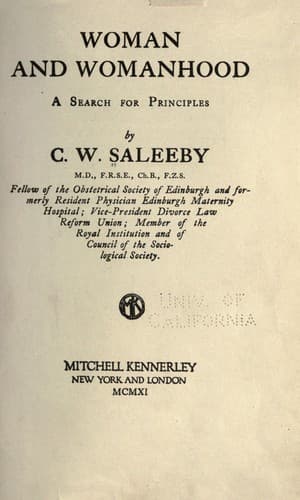
Woman and Womanhood: A Search for PrinciplesSaleeby, C. W. (Caleb Williams)
Science
Woman and Womanhood: A Search for Principles
Saleeby, C. W. (Caleb Williams)
Eugenics; Women
"Some time ago we heard a good deal, both in and out of Parliament,
about the debenture widow whose little all is invested in brewery
securities. There is, on the other hand, the widow so made by
alcohol. I am not aware that anyone has attempted to estimate the
approximate number of each of these two classes. The following is
merely a rude approximation.
It has been stated that there are half a million persons who have
invested money in the licensed trade. Let us allow that half of
these are men. The death-rate of all males, above fifteen years of
age, is slightly over sixteen per 1,000. At the census of 1901, 536
in each 1,000 males aged fifteen years and upwards were found to be
married. Ignoring the differential death-rate of the married as
compared with bachelors and widows, it follows that about 4,100
male investors in the licensed trade die each year, of whom some
2,197 will be married men, leaving behind them the same number of
widows entirely or partly dependent on these investments.
The widows made by drink are nearly six times as many.
Numerous inquiries at home and abroad agree somewhat closely in
stating _14 per cent_. of the entire death-rate to be due to
alcohol. The proportion of one in seven is accepted by Dr. Archdall
Eeid, who considers that all efforts to restrain drinking increase
drunkenness. I do not think the justness of this figure can be
disputed at all, except as an under-estimate. We are here dealing
with male deaths only, and I will do my contention the obvious
injustice of supposing that the proportion of deaths due wholly or
in part to alcohol is no higher amongst men than amongst women. If
one could allow for the existing difference, the result would be
even more terrible.
Taking the figures for 1906 for England and Wales alone, we have
167,307 deaths of males over fifteen; 23,422 of these wholly or
partly due to alcohol, and of this number 12,554 were married men
(i. e., 536 per 1,000). The average size of a family in England and
Wales is 4.62, according to Whitaker. If we multiply the number of
widows, 12,554, by 3.62, we shall have an approximation to the
number of widows and orphans made by alcohol in 1906. There were
45,445, or over 124 widows and orphans made by alcohol every day in
the year.
We may now note some further data helping us to compare the 12,554
alcohol-made widows with the 2,197 whose husbands' fortunes were
wholly or in part bound up with the welfare of the licensed trade.
(Of these latter, also, of course, a large proportion would be
alcohol-made.)
Public-domain text, read in full here on John Shaqi.
Reviews
Reviews
No reviews yet
Be the first to share your thoughts on this work.
Elsewhere in the archive
Join the Discussion
Join the discussion
Sign in to leave a comment or review.
Sign InorCreate an account