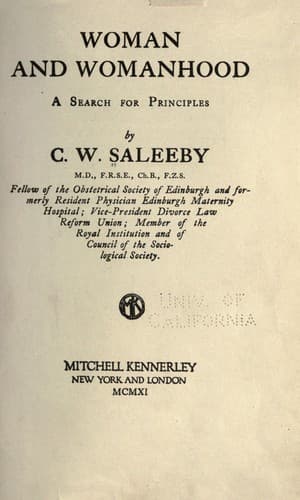
Woman and Womanhood: A Search for PrinciplesSaleeby, C. W. (Caleb Williams)
Science
Woman and Womanhood: A Search for Principles
Saleeby, C. W. (Caleb Williams)
Eugenics; Women
Dr. Tatham's recently published letter on occupational mortality in
the three years, 1900, 1901, 1902, informs us as to twenty-one
occupations in which the alcoholic death-rate is grossly excessive.
In these twenty-one occupations selected by Dr. Tatham as having an
alcohol mortality which exceeds the standard by at least 50 per
cent., we can work out the alcohol factor and find that it amounts
to 24.5 per cent. The table would take up too much space for me to
ask you to print it, but it is ready on demand, public or private.
The figures work out to show that 5,092 married men in these
twenty-one trades died in each year from alcohol. (I have taken
24.5 per cent, of the whole number of deaths in the three years,
and reckoned the married proportion of these.)
The calculation shows that in these twenty-one occupations the
comparative alcohol mortality is 24.5 per cent., as against only 12
per cent. in all other occupations.
Amongst the occupations in Dr. Tatham's table may be noted
coalheaver, coach, cab, etc., service, groom, butcher, messenger,
tobacconist, general labourer, general shopkeeper, brewer, chimney
sweep, dock labourer, hawker, publican, inn and hotel servants. A
glance at the table will show that in most cases the men who are
dying are "industrial drinkers," who frequent public-houses in the
districts where the reduction in the number of the licenses under
the present Bill will occur. Often nowadays the widows are heavy
drinkers, and the lives of their children centre round the
public-house.
If the only wealth of a nation is its life, and history teaches no
more certain truth--and if, since individuals are mortal, the
quantity and quality of parenthood--or of childhood, according to
the point of view--are the supreme factors in the destiny of
nations, do not the foregoing figures warrant the contention that
he who at this date is for alcohol is against England?"
It has been shown that the effect of alcohol upon the brain persists for
not less than thirty hours after the last dose. But more than two years
have now passed since the foregoing was printed, leaving ample time for
any member of the alcoholic party to "pull himself together" and
demolish it. One is therefore entitled to assume that it cannot be
demolished; on the contrary, it could easily be shown that the foregoing
figures very considerably underrate the actual number of widows and
orphans who must be made by alcohol in this country every year.
Public-domain text, read in full here on John Shaqi.
Reviews
Reviews
No reviews yet
Be the first to share your thoughts on this work.
Elsewhere in the archive
Join the Discussion
Join the discussion
Sign in to leave a comment or review.
Sign InorCreate an account