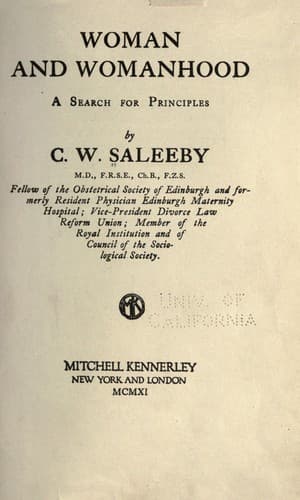
Woman and Womanhood: A Search for PrinciplesSaleeby, C. W. (Caleb Williams)
Science
Woman and Womanhood: A Search for Principles
Saleeby, C. W. (Caleb Williams)
Eugenics; Women
It is very true that on such estimates as those of Lord Kelvin, and
according to what astronomers and geologists believed not more than
twelve or even eight years ago, regarding the secular cooling of earth
and sun--that, according to these, the time is by no means "unending
long," and we may foresee, not so remotely, the end of the solar heat
and light of which we are the beneficiaries. But the discovery of radium
and the phenomena of radio-activity have profoundly modified these
estimates, justifying, indeed, the acumen of Lord Kelvin, who always
left the way open for reconsideration should a new source of heat and
energy in general be discovered. We know now that, to consider the earth
first, its crust is not self-cooling, or at any rate not self-cooling
only, for it is certainly self-heating. There is an almost embarrassing
amount of radium in the earth's crust, so far as we have examined it; a
quantity, that is to say, so great that if the same proportion were
maintained at deeper levels as at those which we can investigate, the
earth would have to be far hotter than it is. Similar reasoning applies
to the sun. Definite, immediate proof of the presence of radium there is
not forthcoming yet, but that presence is far more than probable,
especially since the existence of solar uranium, the known ancestor of
radium, has been demonstrated. The reckonings of Helmholtz and others,
based upon the supposition that the solar energy is entirely derived
from its gravitational contraction, must be superseded. It would require
but a very small proportion of radium in the solar constitution to
account for all the energy which the centre of our system produces; and,
as we have already seen, the earth is to no small extent its own
sun--its own source of heat. The prospect thus opened out by modern
physical inquiry supports more strongly than ever the conviction that
the life of this world to come will be very prolonged. It is true that
there is always the possibility of accident. Encountering another globe,
our sun would doubtless produce so much heat as to incinerate all
planetary life. But the excessive remoteness of the sun from the nearest
fixed star suggests that the constitution of the stellar universe is
such that an accident of this kind is extremely improbable. As for
comets, the earth's atmosphere has already encountered a comet, even
during the brief period of astronomical observation. This thick overcoat
of ours protects us from the danger of such chances.
Public-domain text, read in full here on John Shaqi.
Reviews
Reviews
No reviews yet
Be the first to share your thoughts on this work.
Join the Discussion
Join the discussion
Sign in to leave a comment or review.
Sign InorCreate an account