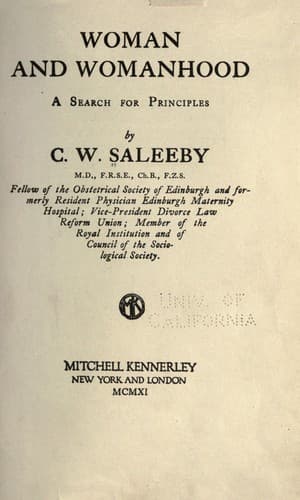
Woman and Womanhood: A Search for PrinciplesSaleeby, C. W. (Caleb Williams)
Science
Woman and Womanhood: A Search for Principles
Saleeby, C. W. (Caleb Williams)
Eugenics; Women
It is quite clear that the supreme choice for any individual or
institution or nation is between unborn to-morrow and dead yesterday. No
one who concerns himself in the current political controversies, as, for
instance, that thing of unspeakable shame which is called the "education
question," will doubt that the present and the future are constantly
being sacrificed to the past. It may be that the spirit of a trust is
being grossly violated; but, rather than infringe the letter of it, the
life of to-day and to-morrow must suffer: thus do the worshippers of
dead yesterday--the most lethal idol before which fond humanity ever
prostrated itself.
If it be our duty to do--not "as though to breathe were life"--and if
nature indicates the future as that which we are to serve, what evidence
have we, or what likelihood, that such service is worth our while? Of
course, such a question as this may be answered in some such terms as
those of the further question, What has posterity done for us? And it is
interesting, perhaps, to consider that, so far as we can judge the
attitude of our ancestors towards ourselves, their chief interest in us
seems to have been as to what we should think of them--"What will
posterity say?" They left their records, as we leave our records, for
posterity to discover. With singular lack of judgment, as I think, we
bury examples of our newspapers for posterity to discover: these are
amongst the things which I should rather not have posterity discover.
But this is no right outlook upon the future. It is not a question of
what posterity can do for us. Posterity is here within us. The life of
the world to come is in our keeping. We carry it about with us in all
our goings and comings. It is at the mercy of what we eat and drink, at
the mercy of the diseases we contract. Its fate is involved when we fall
in love with each other, or out of love with each other; it is we
ourselves. Just as the father who perhaps is losing his own hair may
like to see how pleasantly his children's hair is growing, and finds
consolation therein; just as, indeed, all the hopes of the parent
become gradually transferred from self to that further self, those
further selves, which his children are, so we are to look upon the
future as our continuing self. To ask, What has posterity done for us?
should be looked upon as if one should say, What have my children done
for me? The parallel is indeed a very close one: and it is pointed out
by the fine sentence from Herbert Spencer, which should be known to all
of us--"A transfigured sentiment of parenthood regards with solicitude
not child and grandchild only, but the generations to come
hereafter--fathers of the future, creating and providing for their
remote children."
Public-domain text, read in full here on John Shaqi.
Reviews
Reviews
No reviews yet
Be the first to share your thoughts on this work.
Join the Discussion
Join the discussion
Sign in to leave a comment or review.
Sign InorCreate an account