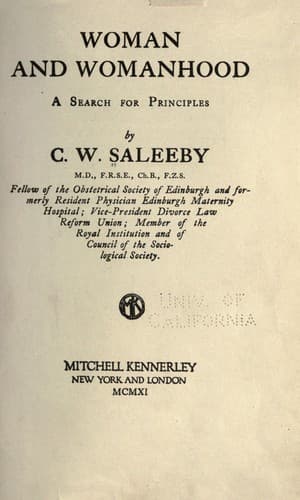
Woman and Womanhood: A Search for PrinciplesSaleeby, C. W. (Caleb Williams)
Science
Woman and Womanhood: A Search for Principles
Saleeby, C. W. (Caleb Williams)
Eugenics; Women
to-day: and human may become superhuman.
Many passages might be quoted to show that our expectation of future
progress is well based, and I will content myself with a single excerpt
from the final page of the masterpiece of which all the civilized world
was lately celebrating the jubilee. Says Darwin: "Hence we may look with
some confidence to a secure future of great length. And as natural
selection works solely by and for the good of each being, all corporeal
and mental endowments will tend to progress towards perfection."
The quotation will suffice to remind us that, if we are to serve the
life of the world to come in the surest way, we must become Eugenists,
accepting and applying to human life Nature's great principle of the
selection of worth for parenthood and the rejection of unworth. We must
modify and adapt our conceptions of education thereto. We must make
parenthood the most responsible thing in life. We must teach the
girl--aye, and the boy too--that the body is holy, for it is the temple
of life to come. We must perceive in our most imperious instincts
Nature's care for the future, and must humanize and sanctify them by
conscious recognition of their purpose, and by provident co-operation
with Nature towards her supreme end. We could spare from education,
perhaps, those fictions concerning the past which are sometimes called
history, were they replaced by a knowledge of our own nature and
constitution as instruments of the future.
Let us grant even, for the argument, that nothing more is possible than
mankind has yet achieved. There remains the hope that that which human
nature at its best has been capable of may be realized by human nature
at large. In their great moments the great men have seen this. That last
sentence is, indeed, a paraphrase from a remark at the end of Herbert
Spencer's "Ethics." Ruskin--to choose the polar antithesis of the
Spencerian mind--declares that "there are no known limits to the
nobleness of person or mind which the human creature may attain if we
wisely attend to the laws of its birth and training." Wordsworth asks
whether Nature throws any bars across the hope that what one is millions
may be. Take it, then, that nothing more is conceivable in the way of
mathematics than a Newton, or of drama than an AEschylus or a
Shakespeare, or of sacrifice than a Christ. These, then, are types of
what will be. They demonstrate what human nature is capable of. What one
is, why may not millions be? Here is an ideal to work for. Here is
something real to worship, to dedicate a life to. It is not merely that
we can make smoother the paths of future generations--which George
Meredith declared to be the great purpose and duty of our lives--but
that, as Ruskin suggests in the foregoing quotation, we may raise the
inherent quality of those future generations, so that they can make
their own ways smooth and straight and high. It is our business, I
repeat, to conceive of parenthood as the most responsible and sacred
Public-domain text, read in full here on John Shaqi.
Reviews
Reviews
No reviews yet
Be the first to share your thoughts on this work.
Join the Discussion
Join the discussion
Sign in to leave a comment or review.
Sign InorCreate an account