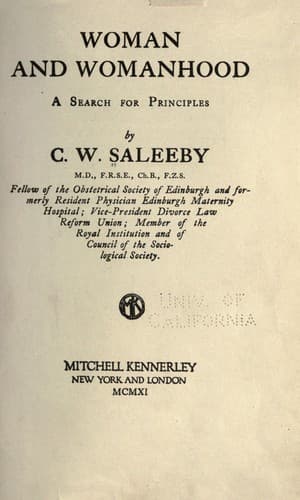
Woman and Womanhood: A Search for Principles — John Shaqi
Woman and Womanhood: A Search for PrinciplesSaleeby, C. W. (Caleb Williams)
Science
Woman and Womanhood: A Search for Principles
Saleeby, C. W. (Caleb Williams)
Eugenics; Women
And if these new observations upon the nature of femaleness were not
enough to warn the writer who should rashly propose, after the fashion
of the unwise, who on every hand lay down the law on this matter, to
state once and for all exactly what, and what only, every woman should
be, we find that another long-held belief as to the relative variety of
men and women has lately been found baseless. It was long held, and is
still generally believed--in consequence of that universal confusion
between the effects of nature and of nurture to which we have already
referred--that women are less variable than men, that they vary within
much narrower limits, and that the bias towards the typical, or mean, or
average, is markedly greater in the case of women than of men. A vast
amount of idle evidence is quoted in favour of a proposition which seems
to have some _a priori_ plausibility. It is said--of course, without any
allusion to nurture, education, environment, opportunity--that such
extreme variations as we call genius are much commoner amongst men than
women: and then that the male sex also furnishes an undue proportion of
the insane--as if there were no unequal incidence of alcohol and
syphilis, the great factors of insanity, upon the two sexes.
Nevertheless, observant members of either sex will either contradict one
another on this point according to their particular opportunities, or
will, on further inquiry, agree that women vary surely no less generally
than men, at any rate within considerable limits, whatever may be the
facts of colossal genius. Indeed, we begin to perceive that differences
in external appearance, which no one supposes to be less general among
women than among men, merely reflect internal differences; and that, as
our faces differ, so do ourselves, every individual of either sex being,
in fact, not merely a peculiar variety, but the solitary example of that
variety--in short, unique. The analysis of the individual now being made
by experimental biology lends abundant support to this view of the
higher forms of life--the more abundant, the higher the form. So vast,
as yet quite incalculably vast, is the number of factors of the
individual, and such are the laws of their transmission in the
germ-cells, that the mere mathematical chances of a second identical
throw, so to speak, resulting in a second individual like any other, are
practically infinitely small. The greater physiological complexity of
woman, as compared with man, lends especial force to the argument in her
case. The remarkable phenomena of "identical twins," who alone of human
beings are substantially identical, lend great support to this
proposition of the uniqueness of every individual: for we find that this
unexampled identity depends upon the fact that the single cell from
which every individual is developed, having divided into two, was at
that stage actually separated into two independent cells, thus producing
Public-domain text, read in full here on John Shaqi.
Reviews
Reviews
No reviews yet
Be the first to share your thoughts on this work.
Join the Discussion
Join the discussion
Sign in to leave a comment or review.
Sign InorCreate an account