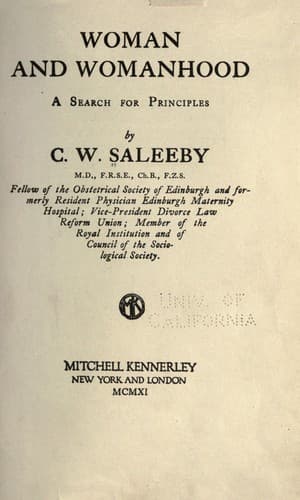
Woman and Womanhood: A Search for PrinciplesSaleeby, C. W. (Caleb Williams)
Science
Woman and Womanhood: A Search for Principles
Saleeby, C. W. (Caleb Williams)
Eugenics; Women
But, secondly, those women and men who assert the doctrine of the
identity of the sexes are led to err, not because it can really be
hidden from the most casual observer that there is a profound
distinction between the sexes, apart from the case of the defeminized
woman--but because, by a surprising fallacy, they confuse the doctrine
of sex-equality with that of sex-identity; or, rather, they believe that
only by demonstrating the doctrine that the sexes are substantially
identical, can they make good their plea that the sexes should be
regarded as equal. The fallacy is evident, and would not need to detain
us but for the fact that, as has been said, the whole tendency of the
time is towards accepting it--the recent biological proof of the
fundamental and absolute difference between the sexes being unknown as
yet to the laity. Yet surely, even were the facts less salient, or even
were they other than they are, it is a pitiable failure of logic to
suppose, as is daily supposed, that in order to prove woman man's equal
one must prove her to be really identical in all essentials, given, of
course, equal conditions. Controversialists on both sides, and even some
of the first rank, are content to accept this absurd position.
The one party seeks to prove that woman is man's equal because Rosa
Bonheur and Lady Butler have painted, Sappho and George Eliot have
written, and so forth; in other words, that woman is man's equal because
she can do what he can do: any capacities of hers which he does not
share being tacitly regarded as beside the point or insubstantial.
The other party has little difficulty in showing that, in point of fact,
men do things admittedly worth doing of which women are on the whole
incapable; and then triumphantly, but with logic of the order which this
party would probably call "feminine," it is assumed that woman is not
man's equal because she cannot do the things he does. That she does
things vastly better and infinitely more important which he cannot do at
all, is not a point to be considered; the baseless basis of the whole
silly controversy being the exquisite assumption, to which the women's
party have the folly to assent, that only the things which are common in
some degree to both sexes shall be taken into account, and those
peculiar to one shall be ignored.
Public-domain text, read in full here on John Shaqi.
Reviews
Reviews
No reviews yet
Be the first to share your thoughts on this work.
Join the Discussion
Join the discussion
Sign in to leave a comment or review.
Sign InorCreate an account