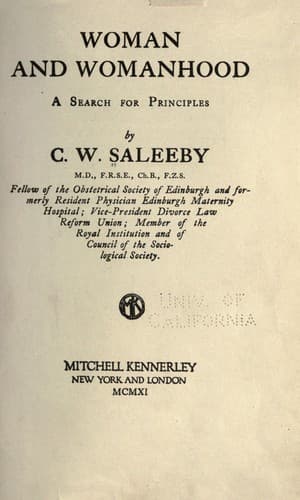
Woman and Womanhood: A Search for PrinciplesSaleeby, C. W. (Caleb Williams)
Science
Woman and Womanhood: A Search for Principles
Saleeby, C. W. (Caleb Williams)
Eugenics; Women
One may be permitted a little longer to delay the discussion of the
distinctive purpose and character of womanhood, because the foregoing
has already stated in outline the teaching which biology and physiology
so abundantly warrant. For here we must briefly refer to the work of a
very remarkable woman, scarcely known at all to the reading public,
either in Great Britain or in America, and never alluded to by the
feminist leaders in those countries, though her works are very widely
known on the Continent of Europe, and, with the whole weight of
biological fact behind them, are bound to become more widely known and
more effective as the years go on. I refer to the Swedish writer, Ellen
Key, one of whose works, though by no means her best, has at last been
translated into English. All her books are translated into German from
the Swedish, and are very widely read and deeply influential in
determining the course of the woman's movement in Germany. At this
early stage in our argument I earnestly commend the reader of any age or
sex to study Ellen Key's "Century of the Child." It is necessary and
right to draw particular attention to the teaching of this woman since
it is urgently needed in Anglo-Saxon countries at this very time, and
almost wholly unknown, but for this minor work of hers and an occasional
allusion--as in an article contributed by Dr. Havelock Ellis to the
_Fortnightly Review_ some few years ago. Especial importance attaches to
such teaching as hers when it proceeds from a woman whose fidelity to
the highest interests, even to the unchallenged autonomy, of her sex
cannot be questioned, attested as it is by a lifetime of splendid work.
The present controversy in Great Britain would be profoundly modified in
its course and in its character if either party were aware of Ellen
Key's work. The most questionable doctrines of the English feminists
would be already abandoned by themselves if either the wisest among
them, or their opponents, were able to cite the evidence of this great
Swedish feminist, who is certainly at this moment the most powerful and
the wisest living protagonist of her sex. From a single chapter of the
book, to which it may be hoped that the reader will refer, there may be
quoted a few sentences which will suffice to indicate the reasons why
Ellen Key dissociated herself some ten years ago from the general
feminist movement, and will also serve as an introduction from the
practical and instinctive point of view to the scientific argument
regarding the nature and purpose of womanhood, which must next concern
us. Hear Ellen Key:--
Public-domain text, read in full here on John Shaqi.
Reviews
Reviews
No reviews yet
Be the first to share your thoughts on this work.
Join the Discussion
Join the discussion
Sign in to leave a comment or review.
Sign InorCreate an account